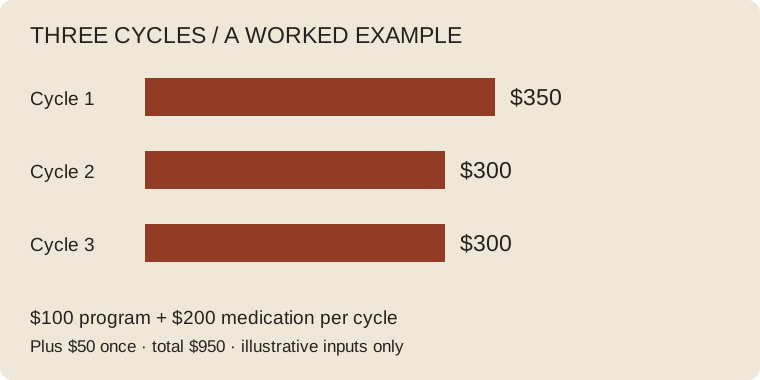
A workable GLP-1 budget starts with a payment schedule, not the smallest number on a provider’s homepage. You need to know what leaves your account first, what repeats, and what remains outside the quoted price. For a simple hypothetical example, suppose a written quote lists a $100 program fee and $200 medication charge per cycle, plus a one-time $50 initial fee. Over three cycles, that totals $950. These are invented teaching numbers, not a provider quote.
The arithmetic is straightforward; deciding which numbers belong in it takes more work. Official pages from CoreAge Rx, Ro, Enhance.MD, Sesame, Walgreens and Found illustrate different arrangements: separate memberships, bundled compounded medication, prepaid plans and per-visit care. Some also contain conflicting billing language. This guide uses documents consulted October 19, 2026, to show how to build your own budget—not to rank providers or predict what treatment you will receive.
At a glance
- Separate charges
- Ro says its Body membership excludes medication; the membership is $39 for the first month, then $149 on the monthly plan, with prepaid alternatives.Sources: [2]
- Four-week billing
- Enhance.MD’s Core page labels its shortest plan $249 per month but specifies billing every four weeks and advertises $50 off the first order.Sources: [4]
- Visit-based costs
- Walgreens advertises initial visits starting at $49 and follow-up chat visits or additional video visits at $49 each, without a subscription; medication is separate.Sources: [9]
- Laboratory exceptions
- Sesame includes qualifying Quest laboratory work, but excludes Quest facilities in nine named states, where laboratory fees are additional.Sources: [17]
Turn the quote into a three-cycle ledger
For the hypothetical example, assume the $100 program charge and $200 medicine charge recur unchanged for exactly three cycles. Assume the $50 initial fee occurs only once and that the quote lists no other charges. The first cycle costs $350, the second $300 and the third $300: $950 altogether. This is a calculation under stated assumptions, not an estimate of typical GLP-1 spending, a treatment recommendation or an actual offer from any company.
Use the table as a structure for your own written quote, replacing every teaching number. Record both the amount and its trigger: enrollment, clinical review, pharmacy fulfillment or renewal. A single total can hide the fact that different businesses collect different payments on different dates. Ro explicitly separates medication from membership, for example. Our explanation of why the first payment can differ can help you distinguish an initial charge from the recurring budget.
| Budget item | Assumed charge | Three-cycle amount |
|---|---|---|
| Program | $100 each cycle | $300 |
| Medication | $200 each cycle | $600 |
| Initial fee | $50 once | $50 |
| Payment sequence | $350, then $300, then $300 | $950 total |
Define the cycle before counting payments
Write the exact cycle length beside each recurring charge. “Monthly” is not precise enough when a page also says every 28 days. Sesame advertises a $99 month-to-month option, but its advance-billing explanation specifies every 28 days. Enhance.MD describes Core plans as one, three, six and 12 months while specifying billing every four, 12, 24 and 48 weeks. Preserve those actual intervals rather than converting the labels into calendar months.
Ask for the first collection date, subsequent collection dates and the service period each payment covers. Found illustrates why this matters: its terms describe four-week billing, while its commercial pricing page ties minimum advertised prices to 12-month plans paid upfront. Those descriptions do not settle your checkout arrangement. A named package duration alone does not establish how much medicine ships or the minimum commitment. The billing-cycle guide explains how to keep interval, payment timing and plan duration separate.
Separate a monthly equivalent from money due today
Ro’s membership demonstrates the difference between an installment-sized headline and an actual collection schedule. It advertises $39 for the first month, then $149 monthly if you remain on the monthly plan. Its lowest advertised membership equivalent is $74 per month when you prepay annually. Other options display $99 per month prepaid every three months and $89 per month prepaid every six months. Medication remains additional under these membership descriptions.
Do not put a monthly equivalent into your cash-flow ledger as though that amount will be collected monthly. Request the exact initial collection and renewal collection for the plan you choose, including how the introductory month interacts with prepayment. Equally, do not assume prepayment is mandatory when a monthly alternative exists. Enhance.MD’s longer Core plans also need a checkout total: its $212 monthly display belongs to the plan labeled 12 months, billed every 48 weeks, rather than its shortest plan.
Match the medicine price to the exact product
Your medication line should name the medicine, formulation, route, presentation and supply period. Walgreens’ eligible self-pay Wegovy injection offer, for example, lists $199 per fill for the first two fills, limited to the 0.25 mg and 0.5 mg presentations for new users through December 31, 2026. Subsequent fills are advertised at $349. Each fill is a 28-day supply, and visits cost extra. Those presentation details identify the price conditions, not instructions about which dose you should use.
A different route can have different pricing and supply definitions. Walgreens lists oral Wegovy at $149 for the 1.5 mg presentation, $199 for 4 mg and $299 for 9 mg or 25 mg, with 30 tablets covering 30 days for eligible self-pay patients. CoreAge Rx instead advertises compounded semaglutide starting at $79 monthly and compounded tirzepatide starting at $129, with supplies and free shipping. Its sampled pages do not establish the supply quantities or conditions that secure those minimum prices.
Price the services that sit around the prescription
Build a separate list for consultations, follow-up, laboratory work, supplies and shipping, even if the quote marks them included. Ro describes necessary laboratory testing, coaching, check-ins and individual messaging within membership, but excludes medication. Enhance.MD’s Core page includes four weeks of semaglutide, ongoing care, essential supplies, wellness coaching, educational access and metabolic testing every six months. These are materially different packages; comparing only the largest advertised dollar figure misses what each payment buys.
Sesame’s laboratory inclusion is narrower than a blanket promise of free testing. It applies to Quest facilities except those in Arizona, Hawaii, North Dakota, New Jersey, New York, Oklahoma, Rhode Island, South Dakota and Wyoming; laboratory charges there are additional. Walgreens follows another model: initial visits start at $49, while follow-up chat visits and additional video visits cost $49 each. Its separately advertised 24/7 pharmacy chat does not establish that clinician follow-ups are free. Use an included-costs checklist to mark each item included, separate or unresolved.
Treat insurance and pharmacy channels as budget conditions
“With insurance” does not mean every line of the budget is covered. Ro says insurance does not cover its membership and limits insurance coordination to Wegovy pen, Zepbound autoinjector pen and Ozempic. Its public-plan rules also differ: certain cash-pay options may be available with Medicare, Medicare supplements or TRICARE; FEHB members can access insurance coordination; Medicaid and some other government-funded plans currently preclude treatment. Confirm your particular pathway before applying an advertised price.
Pharmacy choice can change the bill too. Enhance.MD says a prescription sent to your chosen pharmacy creates a separate medication bill. Found’s compounded-plan terms exclude applicable labs, while insured visits can bring additional copays; its billing consent says compounded medication charges are the patient’s responsibility, not insurance claims. For Sesame, promotional access also has boundaries: its Wegovy injection promotion excludes people enrolled in federal or state health programs with prescription coverage and does not discount subscription fees. Separately, Sesame’s telemedicine terms require users to certify that they are not federal health care program beneficiaries, including Medicare, Medicaid or TRICARE. Confirm service eligibility, not just promotional eligibility, before paying.
Add an exit column, not an assumed refund
Next to each payment, note when it becomes nonrefundable and what cancellation actually stops. CoreAge Rx’s FAQ advertises an automatic full refund if a prescription is not approved, but its policy retains an applicable $50–$100 consultation fee. The policy also makes prescription sales final after approval and transmission to the pharmacy—even before shipment—and generally makes orders nonrefundable 30 calendar days after purchase, even if unfinished or unshipped, except where applicable law requires otherwise.
Renewal cancellation is a different question. Sesame’s program page describes cancellation before the next cycle, while its general terms require email or phone cancellation at least 48 hours before renewal processing. Those terms provide no prorated refund for the current paid term. Found recommends canceling or pausing at least 48 hours before renewal and calls renewal payments nonrefundable. Get the applicable deadline in writing and retain confirmation. Our cancellation and refund explainer separates stopping future charges from recovering money already paid.
Keep unresolved amounts visible
A useful budget has an “unresolved” category rather than silently assigning zero to missing costs. Walgreens’ supplied documents do not establish laboratory requirements or their cost. Ro’s sampled pages do not settle general prepaid cancellation and unused-balance refunds. Enhance.MD’s documents do not reconcile general 28-day renewal language with longer billing intervals. CoreAge Rx’s pages disagree about pre-review collection versus medication billing at shipment. Ask support to identify the controlling terms for your selected order, not simply repeat the homepage.
Cost comparison also requires clinical boundaries. FDA says compounded preparations are not approved and recommends them when an individual’s medical needs cannot be met by an approved drug; nonapproval alone does not establish clinical inequivalence. Do not budget on an assumption that different formulations are interchangeable. For an injectable delivery arriving warm or insufficiently refrigerated, FDA advises not using it and contacting the provider or dispensing pharmacy. Ask about replacement responsibility before payment, rather than treating uncertain delivery remedies as guaranteed credits.
Questions & answers
Does Ro’s advertised membership price include medication?
No. Ro explicitly separates medication from membership. Ask for the first membership collection, the selected renewal or prepaid collection, and the medication charge separately. Its $74 monthly membership equivalent requires annual prepayment; the ongoing monthly-plan membership is $149 after the advertised $39 first month.
Can I treat Enhance.MD’s $212 Core display as a monthly payment?
Not without confirmation. The product page assigns $212 per month to a plan labeled 12 months and billed every 48 weeks, with advertised first-order discount conditions. Request the exact amount collected upfront and at renewal. The supplied material does not establish that checkout total.
Will CoreAge Rx refund everything if I am not approved?
The documents conflict. Its FAQ promises 100%, but its policy retains an applicable $50–$100 consultation fee. Ask which applies before paying. Approved refunds are generally processed within five to 10 business days, with additional bank time possible; processing is not guaranteed bank receipt.
What should I confirm about Sesame’s subscription quote?
Confirm the selected clinician’s price, whether the cycle is 28 days or calendar-month based, and laboratory coverage in your state. Sesame says clinicians set their own prices and some charge more than advertised. Medication is separate, and the $59 starting subscription rate requires an annual subscription.
Does Walgreens’ no-subscription model mean no recurring care costs?
No. Walgreens charges per visit: the initial consultation starts at $49, and follow-up chat or additional video visits are $49 each. Medication is additional. Request the expected follow-up process and budget for documented charges without inventing a fixed visit frequency that the supplied pages do not establish.
What extras should a Found quote address?
Ask about applicable labs, insured-visit cost sharing and missed appointments. Found excludes labs from its compounded-plan inclusions and describes a $30 fee for a missed scheduled consultation or cancellation with less than 24 hours’ notice. Its branded GLP-1 membership plan excludes the medication itself.
Our assessment
The hypothetical $950 total is reliable only because every assumption is explicit: three unchanged cycles, two recurring charges and one initial fee. Your real budget should be equally transparent, even when the final answer is that a cost remains unresolved. Separate today’s payment from later collections, preserve the actual billing interval, identify the exact medication and pharmacy channel, and record cancellation boundaries. A low introductory price can be useful, and a bundled plan can simplify administration. Neither substitutes for a written schedule that explains what you owe, when you owe it and what the payment actually includes.
Sources & documentation
Public materials consulted October 19, 2026. Provider statements are attributed claims, not independently verified clinical outcomes. Terms can change; obtain a current written quote.
- FDA concerns with unapproved GLP-1 drugs used for weight loss ↗
- Ro — weight loss/pricing ↗
- CoreAge Rx — returns refund policy ↗
- Enhance.MD — product/core semaglutide ↗
- Sesame / Success by Sesame — terms of service ↗
- Enhance.MD — official website ↗
- Enhance.MD — faq ↗
- CoreAge Rx — faq ↗
- Walgreens / Walgreens Weight Management — topic/virtual healthcare/weight loss.jsp ↗
- CoreAge Rx — official website ↗
- Sesame / Success by Sesame — terms/offer terms v3 ↗
- Sesame / Success by Sesame — medication/wegovy ↗
- Enhance.MD — terms of service ↗
- Ro — weight loss/insurance ↗
- Walgreens / Walgreens Weight Management — topic/pharmacy.jsp ↗
- Sesame / Success by Sesame — plans and pricing ↗
- Sesame / Success by Sesame — service/online weight loss program ↗
- Sesame / Success by Sesame — insurance ↗
- Sesame / Success by Sesame — terms/payment and billing consent ↗