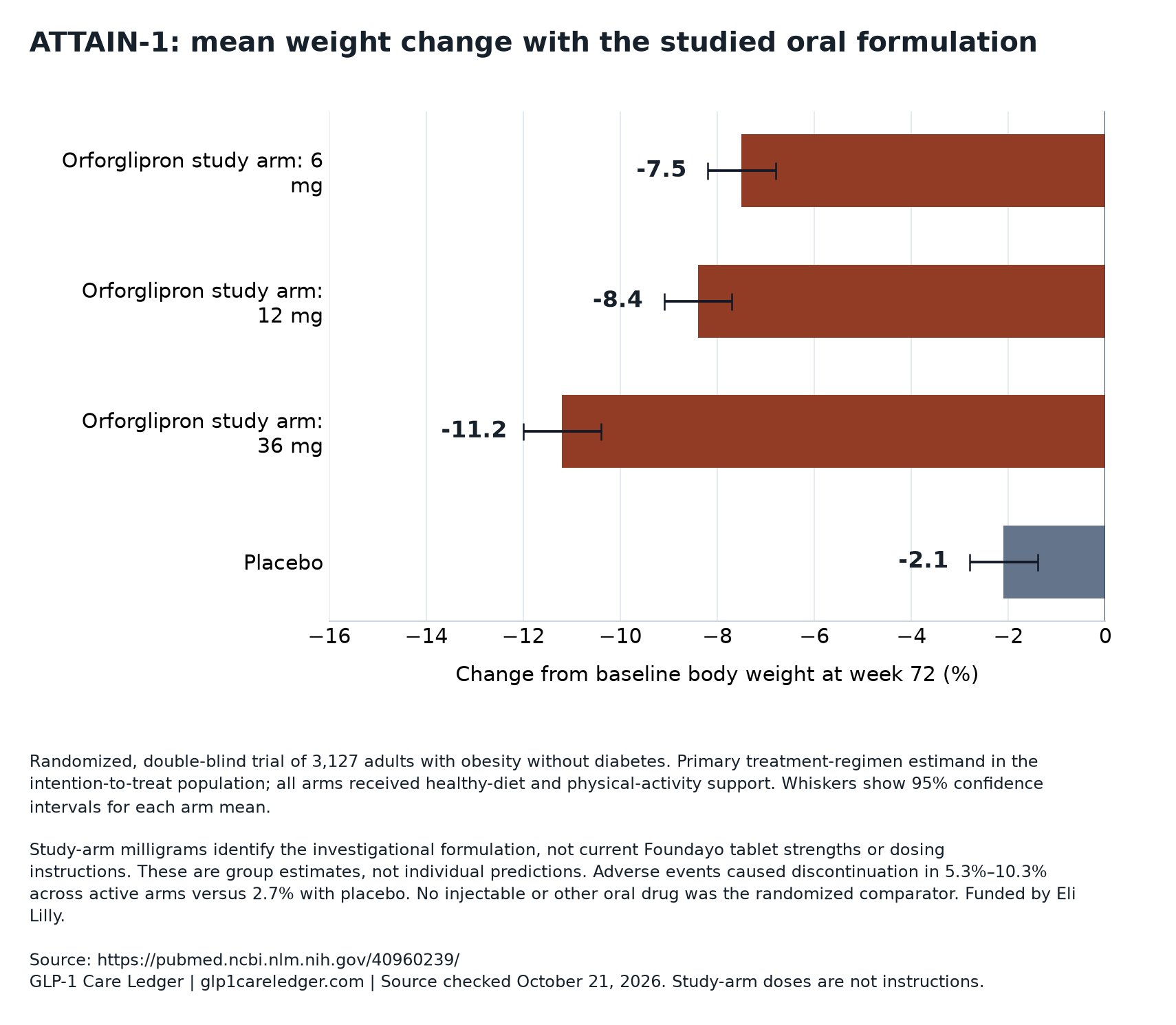
ATTAIN-1 provides substantial randomized evidence for oral orforglipron in adults without diabetes. In the published primary analysis, the highest study-dose group lost an estimated 11.2% of starting body weight over 72 weeks, compared with 2.1% with placebo. That is a meaningful difference, but the number is not a promise for every patient, a comparison against another active drug, or evidence that a particular care program will reproduce the trial.
The details matter especially when trial results appear beside subscription offers. ATTAIN-1 used an investigational formulation, while Foundayo is now US-approved under labeling that identifies different marketed strengths. This analysis uses the indexed primary research abstracts and available official labeling and FDA material; it does not represent a review of every research protocol, supplement, or full journal article. The central question is what the evidence actually estimates—and how faithfully a commercial claim preserves that meaning.
At a glance
- Trial design
- ATTAIN-1 randomized 3,127 adults without diabetes to three once-daily oral orforglipron study arms or placebo for 72 weeks, with diet and physical activity support.Sources: [1]
- Primary weight result
- The 36-mg investigational-formulation arm had a mean weight change of −11.2% (95% CI, −12.0 to −10.4), versus −2.1% (−2.8 to −1.4) with placebo.Sources: [1]
- Treatment tolerability
- Adverse events led to treatment discontinuation in 5.3%–10.3% of orforglipron participants, compared with 2.7% receiving placebo; these were not exclusively gastrointestinal events.Sources: [1]
- Current formulation context
- Foundayo received initial US approval in 2026. Its label explicitly distinguishes the investigational formulation used in trials from equivalent marketed dosages.Sources: [2]
What ATTAIN-1 randomized—and who participated
ATTAIN-1 was a multinational, phase 3, double-blind trial: participants and investigators were masked to treatment assignment. Researchers assigned 3,127 participants in a 3:3:3:4 ratio to once-daily oral orforglipron study doses of 6, 12, or 36 mg, or placebo. These milligram amounts identify the investigational study arms, not current prescribing instructions. Both active-treatment and placebo groups received diet and physical activity support.
The indexed abstract describes the population as having obesity without diabetes. The official label gives fuller eligibility information for the same trial, NCT05869903: adults could enter with a body mass index, or BMI, of at least 30, or with BMI of 27 to below 30 plus a weight-related condition. BMI relates weight to height; it does not directly measure body fat.
The label reports a mean starting weight of 103.2 kg and mean BMI of 37. Participants averaged 45 years of age, 64% were female, and 40% had hypertension. Those characteristics help locate the evidence. The trial was not a study of children, pregnancy, or a population with type 2 diabetes. Eli Lilly funded ATTAIN-1, an important disclosure alongside the strengths of randomization and masking.
The primary result estimates treatment assignment, not perfect persistence
The primary endpoint was percentage change in body weight from baseline to week 72. The primary analysis used the intention-to-treat population—all randomized participants—and a treatment-regimen estimand. An estimand is the precisely defined treatment question a statistical analysis aims to answer, including how events such as stopping treatment are handled.
Here, the aim was to estimate the effect of assignment to the treatment regimen rather than restrict the question to people who remained on medication throughout. That distinction is clinically important: tolerability and discontinuation are part of the experience of starting treatment. An efficacy-focused analysis that asks about continued treatment addresses a different question and can produce a different average.
The primary report’s highest-dose result is 11.2% mean weight loss. It should not be silently replaced with a larger efficacy-estimand figure, such as 12.4%, when describing this primary analysis. Nor does intention-to-treat mean every participant had a measured week-72 weight. Preserving randomized assignment and handling missing measurements are separate statistical tasks.
STUDY DATA · GLP-1 Care Ledger
ATTAIN-1: mean weight change with the studied oral formulation
Randomized, double-blind trial of 3,127 adults with obesity without diabetes. Primary treatment-regimen estimand in the intention-to-treat population; all arms received healthy-diet and physical-activity support. Whiskers show 95% confidence intervals for each arm mean.
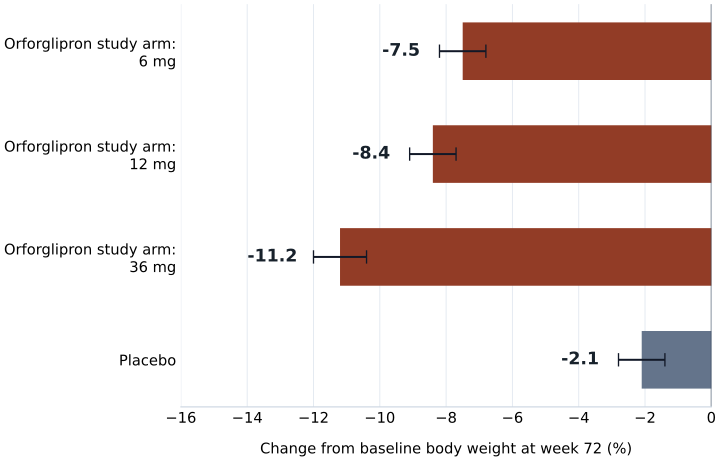
| Study group | Change from baseline body weight at week 72 (%) |
|---|---|
| Orforglipron study arm: 6 mg | -7.5 |
| Orforglipron study arm: 12 mg | -8.4 |
| Orforglipron study arm: 36 mg | -11.2 |
| Placebo | -2.1 |
Study-arm milligrams identify the investigational formulation, not current Foundayo tablet strengths or dosing instructions. These are group estimates, not individual predictions. Adverse events caused discontinuation in 5.3%–10.3% across active arms versus 2.7% with placebo. No injectable or other oral drug was the randomized comparator. Funded by Eli Lilly.
Original visualization of published aggregate data. No individual prediction or provider performance is represented. Original research ↗
Reading the weight estimates without confusing percentages
All three orforglipron arms had greater mean weight reductions than placebo. The published estimates rose across the study doses, from 7.5% to 8.4% to 11.2%. Their confidence intervals describe uncertainty around group means, not a range within which 95% of individual patients’ results should fall. Individual responses can be much more dispersed.
Subtracting the placebo mean gives an additional reduction of 5.4, 6.3, and 9.1 percentage points for the respective study arms. These are arithmetic differences between the published rounded means, not independently reported contrast estimates with confidence intervals. An 11.2% reduction versus 2.1% is therefore a 9.1-percentage-point gap—not a 9.1% relative improvement.
For scale, a hypothetical person starting at 100 kg would lose 11.2 kg if their change exactly matched the highest-dose group mean. That is an illustration, not an individual forecast. The higher study dose also cannot be described as proportionally more effective simply because its milligram amount is larger: dose, exposure, tolerability, and average response need not scale together.
| Randomized study arm | Mean body-weight change | 95% confidence interval |
|---|---|---|
| Orforglipron 6 mg | −7.5% | −8.2% to −6.8% |
| Orforglipron 12 mg | −8.4% | −9.1% to −7.7% |
| Orforglipron 36 mg | −11.2% | −12.0% to −10.4% |
| Placebo | −2.1% | −2.8% to −1.4% |
Response thresholds show variation hidden by the average
In the 36-mg investigational arm, 54.6% of participants reached at least 10% weight loss, 36.0% reached at least 15%, and 18.4% reached at least 20%. Corresponding placebo proportions were 12.9%, 5.9%, and 2.8%. These findings show a shift in the distribution of outcomes, not just a change in the average.
The thresholds overlap. Someone losing 20% also belongs in the groups losing at least 15% and at least 10%. Adding the three percentages would double- or triple-count participants. The highest-dose group’s 54.6% response at the 10% threshold also means that substantial weight loss was not universal, despite the clear average advantage over placebo.
The calculated absolute gaps were 41.7 percentage points at the 10% threshold, 30.1 points at 15%, and 15.6 points at 20%. These are differences in responder proportions, not hazard reductions or changes in mean weight. For evaluating a claim, a threshold result answers a different question from a mean: how frequently a specified degree of loss occurred under the trial analysis.
Missing weights and stopped treatment are different problems
The label reports that 22%–24% of participants in the active Trial 1 groups discontinued trial medication, compared with 30% receiving placebo. Those all-cause discontinuation figures are not the same as discontinuation specifically because of adverse events. They also are not synonymous with leaving the study or having no endpoint measurement: someone can stop medication but still provide follow-up data.
At week 72, weight measurements were missing for 14%–16% of active-treatment participants and 24% of placebo participants. The label describes modified multiple imputation, a statistical method that fills in missing outcomes repeatedly using specified assumptions and available data. Its approach used information from retrieved participants in the same randomized group when missingness was possibly treatment-related, and otherwise observed data from that group.
This makes the result more informative than a simple average among treatment completers, but not assumption-free. The accessible evidence does not permit a complete assessment of every sensitivity analysis. Editorial interpretation: because interruptions mattered in the trial, questions about follow-up access deserve attention in a care contract. The follow-up care guide helps separate those service questions from the drug’s efficacy estimate.
Trial formulation and approved Foundayo are not milligram-for-milligram interchangeable
Foundayo, the approved orforglipron tablet, received initial US approval in 2026. Its indication covers long-term weight reduction and maintenance in eligible adults alongside reduced-calorie diet and increased physical activity. The historical research abstract’s description of orforglipron as investigational should not be repeated as its current regulatory status.
At the same time, the historical formulation remains essential to interpreting ATTAIN-1. The label explicitly states that the trials used an investigational formulation and presents results using equivalent marketed dosages. Consequently, the published study’s 6-, 12-, and 36-mg arm names should not be treated as current tablet strengths or used to create a personal conversion.
The label’s Trial 1 table also reports slightly different weight estimates—7.4%, 8.3%, and 11.1% reductions—than the indexed primary abstract. The accessible material does not establish the precise reason for those small differences. Keeping each set attached to its source is more accurate than mixing figures. A formulation-specific evidence check belongs before the broader questions in the written-quote checklist.
Gastrointestinal effects were common, and some participants stopped
The primary abstract identifies gastrointestinal effects as the most common adverse events, mostly mild to moderate. Adverse events of any type caused treatment discontinuation in 5.3%–10.3% of orforglipron participants, versus 2.7% with placebo. The abstract does not assign each percentage in that range to a specific arm, and the range should not be relabeled as gastrointestinal-only discontinuation.
Official labeling adds detail from a pooled safety analysis of two trials, including one with type 2 diabetes. In that pool, gastrointestinal adverse reactions occurred in 60%–69% of active-treatment participants versus 37% with placebo. Nausea occurred in 26%–35% versus 10%, and vomiting in 13%–24% versus 4%. These pooled figures are useful but are not ATTAIN-1-only rates.
The label reports that nausea, vomiting, and diarrhea were more frequent during dose escalation and declined over time. That pattern does not mean everyone’s symptoms resolved or that persistence is guaranteed. Editorial interpretation: a service offer should make its route for adverse-effect questions clear. The Ro review can be used to check documentary terms, not as evidence that the provider offers the studied product or reproduces trial outcomes.
The label identifies serious risks beyond routine stomach symptoms
Foundayo’s boxed warning requires careful wording. Other GLP-1 receptor agonists that are active in rodents have produced thyroid C-cell tumors. Orforglipron is not pharmacologically active in rats or mice and did not produce rodent tumors; the relevance of receptor-dependent rodent findings to humans remains unknown. The drug is contraindicated with a personal or family history of medullary thyroid carcinoma or multiple endocrine neoplasia syndrome type 2.
In pooled trials, severe gastrointestinal reactions were reported in approximately 3% with orforglipron versus 1% with placebo. Acute kidney injury occurred in 0.2% versus 0.05%. The label warns about kidney injury related to volume depletion, including dehydration associated with gastrointestinal symptoms. Gallstones occurred in 1% versus 0.7%, and acute cholecystitis in 0.4% versus 0.3%.
Adjudicated acute pancreatitis involved six treated patients versus one placebo patient, with exposure-adjusted rates of 0.14 versus 0.04 patients per 100 years of exposure. Those rates are not percentages and cannot be read as individual annual probabilities. Small event counts leave uncertainty about magnitude. The label also addresses interactions, pregnancy, and aspiration during anesthesia; the trial’s average weight benefit does not settle these separate safety questions.
OASIS 4 and SURMOUNT-5 answer different comparison questions
OASIS 4 randomized 307 adults without diabetes, 205 to oral semaglutide 25 mg daily and 102 to placebo, alongside lifestyle interventions. The double-blind study ran 71 weeks, but its coprimary endpoints were assessed at week 64. Mean weight change was −13.6% versus −2.2%; the reported difference was −11.4 percentage points, with a 95% confidence interval of −13.9 to −9.0. Novo Nordisk funded the study.
That larger numerical mean reduction does not establish oral semaglutide’s superiority to orforglipron. Participants were not randomized between the two oral drugs, and endpoint timing, populations, and analysis choices differ. OASIS 4 reported gastrointestinal adverse events in 74.0% versus 42.2%, but comparing those rates directly with another trial’s rates would have the same problem.
SURMOUNT-5 illustrates a genuine active-drug comparison: 751 adults were randomized to weekly subcutaneous tirzepatide or semaglutide for 72 weeks in an open-label trial. Mean reductions were 20.2% and 13.7%, respectively. That Lilly-funded comparison concerns injectable regimens, not the oral products here. The head-to-head analysis explains why direct randomization provides stronger comparative evidence than ranking separate trials.
| Trial | Randomized comparison | Weight endpoint timing |
|---|---|---|
| ATTAIN-1; 3,127 participants | Daily oral orforglipron investigational formulation versus placebo | Week 72 |
| OASIS 4; 307 participants | Daily oral semaglutide 25 mg versus placebo | Week 64 within a 71-week study |
| SURMOUNT-5; 751 participants | Weekly injected tirzepatide versus injected semaglutide | Week 72 |
What the evidence contributes to a care-plan comparison
ATTAIN-1 also reported improvements in waist circumference, systolic blood pressure, triglycerides, and non-HDL cholesterol compared with placebo. These are useful measurements, but they do not establish fewer heart attacks, kidney failures, or deaths. The label marks several cardiometabolic analyses as not controlled for multiplicity, meaning their statistical interpretation must account for the many comparisons made.
Outcome specificity matters across the field: a weight trial is not interchangeable with a trial of another disease endpoint. The ESSENCE liver-evidence analysis examines that distinction in another setting. Likewise, ATTAIN-1 cannot validate an unstudied compounded formulation or a provider’s outcomes. FDA states that compounded drugs are not FDA-approved and do not undergo its premarket review for safety, effectiveness, and quality.
Editorial interpretation: compare the evidence for the exact product separately from payment and access terms. The evidence-and-price guide organizes that distinction, while the Mochi Health review offers another place to check documentary terms only. Neither a subscription price nor a trial citation establishes equivalent care, uninterrupted access, or an individual response. ATTAIN-1 supplies a treatment estimate—not a financial value calculation.
Questions & answers
Does 11.2% mean that most people lost exactly that amount?
No. It is an estimated group mean under the primary treatment-regimen analysis. The responder results demonstrate variation: 54.6% in the highest investigational-dose arm reached at least 10% weight loss, while 18.4% reached at least 20%. Neither the mean nor its confidence interval specifies an individual’s likely range of results.
Why does treatment discontinuation not invalidate the trial?
Stopping medication is an important outcome, not automatically a reason to discard a participant. The treatment-regimen question accommodates discontinuation, while the intention-to-treat population preserves randomized assignment. Missing endpoint measurements still require assumptions, however. The label describes imputation and reports appreciable missing week-72 weights, making that uncertainty relevant to interpretation.
Is the 36-mg study arm a current Foundayo tablet strength?
No. That number identifies an investigational formulation used in the research report. Foundayo is US-approved, and its official labeling presents trial data using equivalent marketed dosages. The published study-arm names should not be used as a tablet-selection guide, a milligram-for-milligram substitution, or a basis for changing an individual regimen.
Does OASIS 4 prove oral semaglutide works better?
No. OASIS 4 establishes an advantage over its own placebo comparator, with weight endpoints at week 64. ATTAIN-1 establishes an advantage over its own placebo comparator at week 72. A reliable comparative claim would require evidence that addresses differences between studies; the two abstracts alone do not establish which oral treatment is superior.
Can a care program apply these results to any oral GLP-1 product?
No. Evidence attaches to the studied drug, formulation, population, and analysis. Official labeling supplies the relevant bridge to marketed Foundayo; a broad claim about oral GLP-1 treatment does not do so. FDA also distinguishes approved drugs from compounded products. Provider-specific outcomes require provider-specific evidence rather than borrowing a pharmaceutical trial’s results.
Our assessment
ATTAIN-1 supports a clear conclusion: assignment to daily oral orforglipron produced greater average weight loss than placebo over 72 weeks in adults without diabetes receiving lifestyle support. Its value lies in the randomized comparison, the treatment-regimen question, and the distribution of responses—not just its largest percentage. Gastrointestinal burden, adverse-event discontinuation, missing measurements, and serious labeled risks remain part of the evidence. For care-plan evaluation, the defensible editorial approach is to verify product identity and current labeling first, then examine follow-up and contract terms separately. Neither the trial nor a favorable payment arrangement guarantees an individual outcome.
Sources & documentation
Scientific and official sources consulted October 21, 2026. Study findings apply to the populations, products and time periods described; they are not provider outcome data.
- Orforglipron, an Oral Small-Molecule GLP-1 Receptor Agonist for Obesity Treatment. ↗
- DailyMed - FOUNDAYO- orforglipron tablet, film coated ↗
- Oral Semaglutide at a Dose of 25 mg in Adults with Overweight or Obesity. ↗
- Tirzepatide as Compared with Semaglutide for the Treatment of Obesity. ↗
- FDA concerns with unapproved GLP-1 drugs used for weight loss ↗