A liver biopsy can show meaningful improvement before a study establishes whether treatment prevents liver failure, transplantation, or death. That distinction is central to ESSENCE, a phase 3 trial of semaglutide in metabolic dysfunction-associated steatohepatitis, or MASH. Its planned 72-week analysis found substantially more favorable liver biopsy results with semaglutide than with placebo. The results are strong evidence of an effect on liver tissue, but the reported analysis does not establish the longer-term clinical outcomes that matter most to patients.
For a long-term care commitment, three questions deserve separate answers: what treatment changed, how long researchers observed it, and what a care arrangement actually costs. ESSENCE answers the first two within a defined population and timeframe; it does not price care or establish cost-effectiveness. This analysis uses the indexed primary research abstracts and available official FDA material, rather than a review of complete trial protocols, supplements, or full articles. The FDA has granted accelerated approval to Wegovy injection for MASH in adults with moderate-to-advanced fibrosis.
At a glance
- Study population
- ESSENCE randomized 1,197 people with biopsy-defined MASH and stage F2 or F3 fibrosis; the planned 72-week analysis covered the first 800.Sources: [1]
- MASH resolution endpoint
- Resolution without worsening fibrosis occurred in 62.9% with semaglutide versus 34.3% with placebo; the reported estimated difference was 28.7 percentage points, with a 95% CI of 21.1–36.2.Sources: [1]
- Fibrosis improvement endpoint
- Fibrosis reduction without worsening MASH occurred in 36.8% versus 22.4%; the estimated difference was 14.4 percentage points, with a 95% CI of 7.5–21.3.Sources: [1]
- Treatment and tolerability
- The study compared once-weekly subcutaneous semaglutide 2.4 mg with placebo. Gastrointestinal adverse events were more common with semaglutide.Sources: [1]
- Approval and remaining question
- FDA accelerated approval rests on a surrogate endpoint. The 240-week trial is designed to examine whether the tissue improvements translate into fewer deaths, transplants, and other liver-related events.Sources: [2]
ESSENCE studied established liver inflammation and scarring
MASH involves liver fat accumulation accompanied by inflammation and injury, with the potential to develop scar tissue. Fibrosis means that scarring; cirrhosis represents a more advanced stage. ESSENCE enrolled people with biopsy-defined MASH and fibrosis stages F2 or F3, a noncirrhotic population with moderate or advanced scarring. It therefore tested more than a change in liver fat or a blood test associated with liver injury.
That entry requirement matters when interpreting the findings. A person with an incidental fatty-liver finding is not automatically comparable to someone whose biopsy establishes MASH and F2 or F3 fibrosis. Likewise, these results should not simply be extended to cirrhosis. The study's disease stage is part of the evidence, not a minor eligibility detail.
The FDA describes MASH as a disease that can progress to cirrhosis, worsening liver function, liver cancer, transplantation, or death. Many people have few symptoms before severe damage develops. This helps explain why tissue endpoints are useful for studying earlier treatment effects: symptom improvement alone may not adequately capture changes in an often-silent disease.
A randomized comparison, with a defined interim window
ESSENCE is a multicenter, randomized, double-blind, placebo-controlled trial funded by Novo Nordisk. Researchers assigned 1,197 participants in a 2:1 ratio to once-weekly subcutaneous semaglutide 2.4 mg or placebo for a planned 240 weeks. Subcutaneous means injected under the skin. The dose identifies the studied treatment arm; it is not an instruction for individual treatment.
The published interim analysis concerned the first 800 participants at week 72: 534 assigned semaglutide and 266 placebo. These are the relevant group sizes for interpreting the reported biopsy percentages, not the full enrollment of 1,197. A planned interim analysis is a specified examination before the overall trial finishes; it is not equivalent to the final long-term results.
According to the FDA account, both groups also received lifestyle changes, including dietary modification and increased physical activity, and participants were on stable doses of relevant metabolic medications. Placebo therefore represented care without the active study drug, not absence of all care. Randomization strengthens the treatment comparison, while blinding helps limit differences arising from knowledge of assignment.
STUDY DATA · GLP-1 Care Ledger
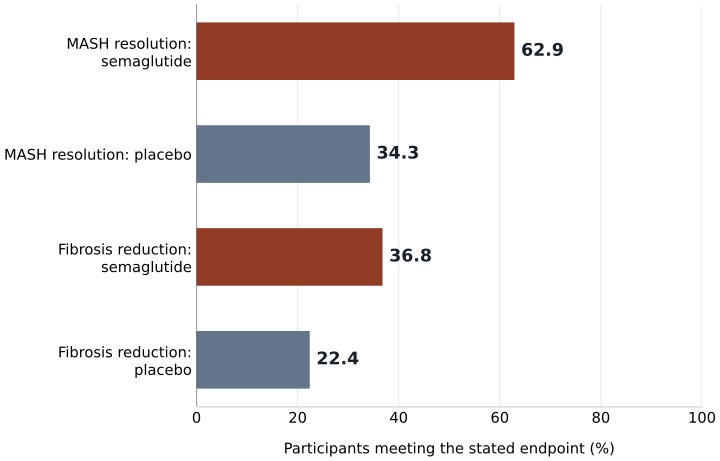
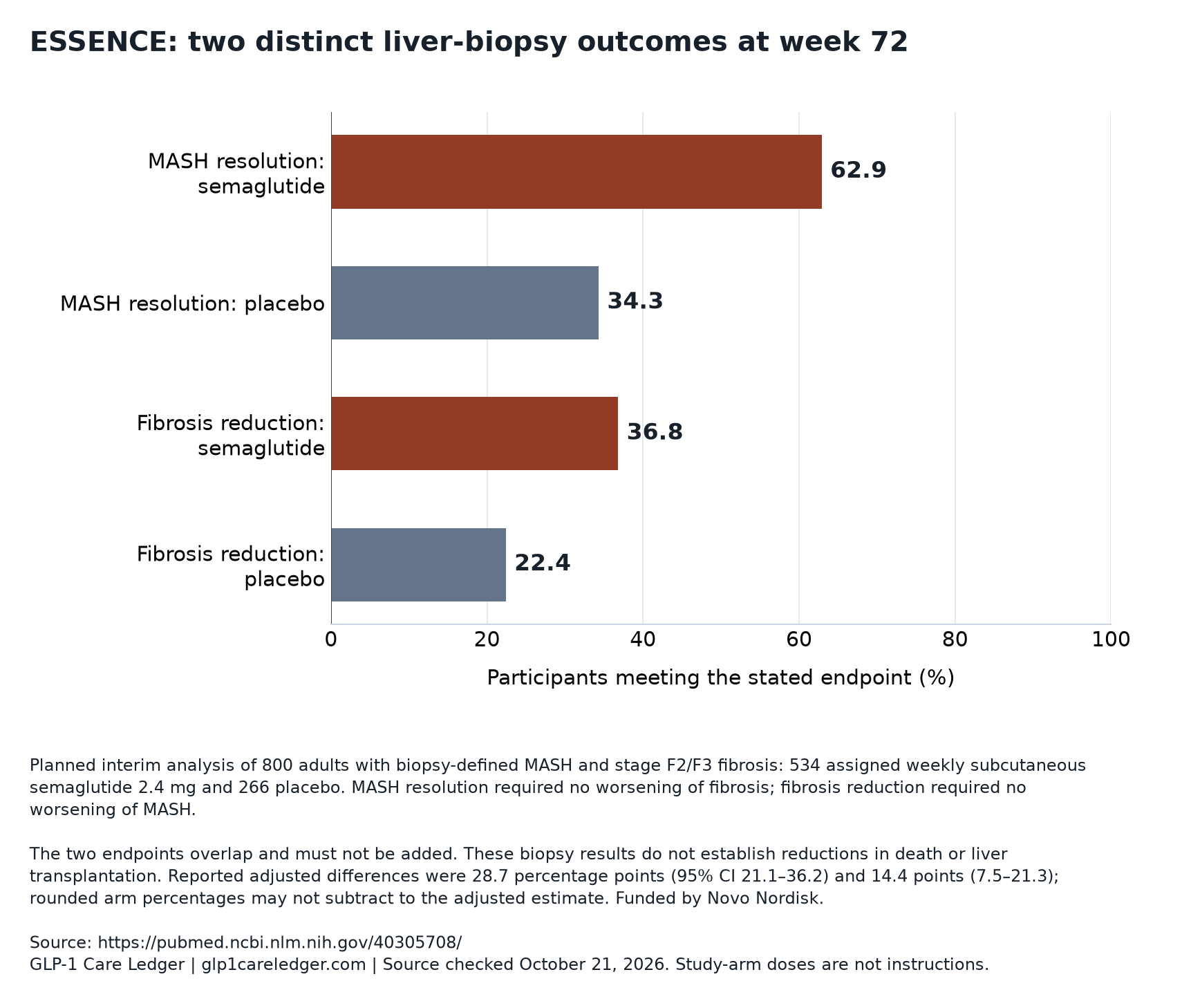
ESSENCE: two distinct liver-biopsy outcomes at week 72
Planned interim analysis of 800 adults with biopsy-defined MASH and stage F2/F3 fibrosis: 534 assigned weekly subcutaneous semaglutide 2.4 mg and 266 placebo. MASH resolution required no worsening of fibrosis; fibrosis reduction required no worsening of MASH.
| Study group | Participants meeting the stated endpoint (%) |
|---|---|
| MASH resolution: semaglutide | 62.9 |
| MASH resolution: placebo | 34.3 |
| Fibrosis reduction: semaglutide | 36.8 |
| Fibrosis reduction: placebo | 22.4 |
The two endpoints overlap and must not be added. These biopsy results do not establish reductions in death or liver transplantation. Reported adjusted differences were 28.7 percentage points (95% CI 21.1–36.2) and 14.4 points (7.5–21.3); rounded arm percentages may not subtract to the adjusted estimate. Funded by Novo Nordisk.
Original visualization of published aggregate data. No individual prediction or provider performance is represented. Original research ↗
Two primary endpoints asked different tissue questions
The first primary endpoint was resolution of steatohepatitis without worsening fibrosis. It asks whether the inflammatory disease process meets the study's resolution criterion while scarring does not deteriorate. It does not require scarring to improve, nor does it mean the liver has become entirely normal. The second endpoint required fibrosis reduction without worsening steatohepatitis, placing the emphasis on improvement in scar tissue.
Both endpoints favored semaglutide. MASH resolution without worse fibrosis occurred in 62.9% versus 34.3%. Fibrosis reduction without worse MASH occurred in 36.8% versus 22.4%. Their different response rates show why inflammatory resolution and scar reduction should not be treated as interchangeable achievements. Each endpoint protects against improvement in one feature being accompanied by deterioration in the other.
These are histologic endpoints: outcomes assessed through tissue examination. Their strength is that they directly evaluate important features of the liver disease. Their boundary is equally specific: a favorable biopsy classification is not itself a counted episode of avoided liver failure or an observed extension of life.
| Endpoint | Semaglutide vs. placebo | Reported estimated difference, percentage points (95% CI) |
|---|---|---|
| MASH resolution without worsening fibrosis | 62.9% vs. 34.3% | 28.7 (21.1–36.2) |
| Fibrosis reduction without worsening MASH | 36.8% vs. 22.4% | 14.4 (7.5–21.3) |
| Both MASH resolution and fibrosis reduction | 32.7% vs. 16.1% | 16.5 (10.2–22.8) |
Reading the size and uncertainty of the biopsy gains
The reported 28.7-percentage-point difference in MASH resolution describes an absolute between-group contrast. As an interpretation of scale, it corresponds to roughly 29 additional endpoint responses per 100 people under the study comparison. It is not a 28.7% relative reduction in liver failure. The fibrosis endpoint's 14.4-point difference concerns a different tissue response and must retain that label.
The abstract reports estimated differences rather than simply subtracting the displayed rounded percentages. For resolution, 62.9 minus 34.3 equals 28.6, but the reported estimate is 28.7. Similarly, the joint endpoint's displayed percentages subtract to 16.6 while its reported estimate is 16.5. The published estimates should be preserved; the abstract does not provide enough analytical detail to reconstruct them.
The 95% confidence intervals show the precision of those estimates under the analysis: 21.1–36.2 points for resolution and 7.5–21.3 for fibrosis reduction. Both exclude zero, supporting a positive treatment difference. They do not give an individual's probability of response or describe uncertainty about eventual transplantation and survival. Those are separate outcomes requiring their own observations.
Combined improvement, weight change, and pain tell different stories
A secondary endpoint required both resolution of steatohepatitis and reduction in fibrosis. It occurred in 32.7% with semaglutide and 16.1% with placebo, with a reported difference of 16.5 percentage points and a 95% confidence interval of 10.2–22.8. This is a more demanding joint outcome than improvement in only one dimension. The response categories overlap, so their percentages cannot be added to produce a total benefit rate.
Mean body weight changed by −10.5% with semaglutide and −2.0% with placebo. The estimated between-group difference was −8.5 percentage points, with a 95% confidence interval of −9.6 to −7.4. These are group-average percentage changes in weight, not pounds lost and not a guarantee of any particular participant's result.
Weight, joint biopsy improvement, and bodily pain were the three secondary outcomes included in the plan to adjust for multiple testing. Pain scores did not differ significantly between groups. That result separates a tissue benefit from a demonstrated symptomatic benefit. Meanwhile, simultaneous weight and liver improvements do not establish how much of the liver effect was caused by weight loss; this abstract does not resolve that mechanism.
Accelerated approval recognizes benefit while requiring confirmation
Wegovy injection has an FDA-approved MASH indication for adults with moderate-to-advanced fibrosis. Describing this use as still investigational would miss that regulatory action. The approval used the accelerated pathway, which allows earlier approval for a serious condition based on a surrogate endpoint, with additional evidence required to confirm clinical benefit.
A surrogate endpoint stands in for a later outcome of direct importance to how people feel, function, or survive. Here, biopsy improvement provides evidence that treatment changes disease features plausibly relevant to future health. It does not, by itself, establish the size or timing of any reduction in liver-related complications.
The FDA describes the ongoing 240-week trial as examining whether the changes seen after 72 weeks translate into fewer deaths, liver transplants, and other liver-related events. That duration is about 4.6 years, compared with about 1.4 years for the interim assessment. Neither interval automatically defines the necessary treatment duration for an individual. The report also does not establish whether biopsy gains persist after treatment ends.
Tolerability belongs alongside the response percentages
ESSENCE reported more gastrointestinal adverse events with semaglutide than with placebo. The accessible abstract does not give their counts, severity distribution, or treatment-discontinuation rates. Consequently, this analysis can identify the direction of the tolerability difference but cannot calculate an ESSENCE-specific excess frequency or estimate how often adverse effects prevented continued treatment.
The FDA approval announcement lists common effects including nausea, diarrhea, vomiting, constipation, abdominal pain, indigestion, and fatigue, among others. It also identifies restrictions involving a personal or family history of medullary thyroid cancer, multiple endocrine neoplasia type 2, and known sensitivity to semaglutide or product ingredients. The announcement is not complete current prescribing information.
Safety and benefit are different dimensions of the same treatment decision. A higher biopsy-response percentage does not erase adverse effects, and an adverse effect does not establish that a participant received no liver benefit. Editorial interpretation: a care budget should distinguish medication access from ongoing clinical support, without assuming a particular visit schedule. The follow-up care cost guide addresses that accounting distinction, not a trial-tested monitoring plan.
SELECT and FLOW measured other outcomes in other populations
SELECT studied 17,604 adults aged at least 45 with established cardiovascular disease, BMI of at least 27, and no diabetes history. Weekly injected semaglutide 2.4 mg was compared with placebo. Over mean follow-up of 39.8 months, cardiovascular death, nonfatal heart attack, or nonfatal stroke occurred in 6.5% versus 8.0%; the hazard ratio was 0.80, with a 95% confidence interval of 0.72–0.90.
FLOW instead enrolled 3,533 people with type 2 diabetes and chronic kidney disease defined by kidney function and urinary albumin criteria. It compared weekly injected semaglutide 1.0 mg with placebo. At median follow-up of 3.4 years, after recommended early cessation at a prespecified analysis, there were 331 versus 410 first primary events. The kidney-event or kidney/cardiovascular-death composite had a hazard ratio of 0.76, with a 95% confidence interval of 0.66–0.88.
Both Novo Nordisk-funded trials measured event outcomes rather than liver-biopsy responses. Hazard ratios compare event rates over time, not percentage-point differences. Neither lower composite hazard establishes improvement in every component. SELECT reported adverse-event discontinuation in 16.6% versus 8.2%; FLOW reported serious adverse events in 49.6% versus 53.8%. These are different safety measures. The separate SELECT analysis and FLOW analysis explain their distinct clinical settings.
| Trial and population | Studied weekly injection | Main reported endpoint and observation window |
|---|---|---|
| ESSENCE: biopsy-defined MASH, F2/F3 fibrosis | 2.4 mg vs. placebo | Two biopsy endpoints at 72 weeks; longer trial planned for 240 weeks |
| SELECT: established cardiovascular disease, overweight or obesity, no diabetes | 2.4 mg vs. placebo | Cardiovascular death, nonfatal heart attack, or nonfatal stroke; mean follow-up 39.8 months |
| FLOW: type 2 diabetes and defined chronic kidney disease | 1.0 mg vs. placebo | Kidney events or kidney/cardiovascular death; median follow-up 3.4 years |
The evidence follows the studied product, not every semaglutide offer
ESSENCE tested a particular injected semaglutide regimen under randomized trial conditions. Its results do not automatically validate oral semaglutide, different formulations, compounded preparations, or any commercial provider's service. A shared ingredient name does not demonstrate equivalent exposure, quality, effectiveness, or clinical support. Our ATTAIN-1 oral-treatment analysis examines a different molecule, route, population, and weight endpoint; those findings cannot substitute for ESSENCE’s liver-biopsy evidence.
The FDA states that compounded GLP-1 drugs are not FDA approved and do not undergo its premarket review for safety, effectiveness, and quality. It has received reports of dosing errors involving compounded injectable semaglutide, including some requiring hospitalization. Those reports identify real concerns but do not provide a controlled comparison or an incidence rate that can be placed beside ESSENCE's response percentages.
Editorial interpretation: comparing offers therefore requires keeping product identity separate from service terms. The approved-versus-compounded pricing guide provides a framework for that distinction. A Ro review can be used to check documentary membership and payment terms; that link does not establish that the provider offers the ESSENCE product, MASH-specific care, or trial-like outcomes.
A care commitment needs a separate financial ledger
ESSENCE reports neither prices nor insurance coverage, and it does not calculate cost-effectiveness. No dollar value can be assigned to its biopsy differences from these results alone. Estimating economic value would require additional information about treatment costs, clinical events, quality of life, duration of benefit, and the alternatives being compared.
Editorial interpretation: the 72-week evidence window is a useful reference for understanding what was observed, not a scientifically established subscription length. Likewise, 240 planned trial weeks are not a recommendation to prepay for that period. Contract duration and biological treatment duration are different variables, and neither can be inferred from the other.
A practical financial review can identify what a written quote includes, how renewals work, and which charges remain uncertain without predicting medical savings. The budget workbook supports that separate exercise. For another documentary comparison, the Mochi Health review invites checking written payment terms only; it is not evidence of MASH treatment availability or benefit. Price describes an offer, whereas ESSENCE describes measured effects in a defined trial.
Questions & answers
Does MASH resolution mean the liver is cured?
No. In ESSENCE, resolution was paired with no worsening of fibrosis, not a requirement that all scar tissue disappear. A separate endpoint evaluated fibrosis reduction. The results establish favorable tissue classifications at 72 weeks, not permanent elimination of disease or protection from every future liver complication.
Why did so many placebo participants improve?
The placebo group also received lifestyle changes and background care. Its 34.3% resolution rate is part of the observed comparison, not evidence that placebo alone caused recovery. The abstract does not separate the contributions of lifestyle changes, disease variation, or other factors. Randomization makes the between-group difference more informative than either response rate in isolation.
Did ESSENCE prove fewer liver transplants or deaths?
Not in the reported 72-week analysis. Its primary outcomes were biopsy-based. The FDA describes the continuing 240-week trial as testing whether those improvements translate into reductions in death, transplantation, and other liver-related events. That distinction concerns this interim report and does not make a claim about every subsequent publication.
Can the weight loss explain the liver improvement?
It may contribute, but the reported results do not quantify that contribution. Randomization compared semaglutide with placebo; it did not separately randomize people to equivalent weight loss through different mechanisms. The FDA describes weight loss and potentially other incompletely understood mechanisms. An average weight difference cannot establish a causal breakdown of the biopsy benefit.
Does a longer or more expensive care plan promise more liver benefit?
No such comparison was tested. ESSENCE compared treatment groups, not subscription prices, providers, or contract lengths. Editorial interpretation: documentary terms can establish financial obligations, but they cannot establish additional medical benefit. Nor does a lower-priced formulation inherit the trial results merely because it is advertised using the semaglutide name.
Our assessment
ESSENCE provides persuasive randomized evidence that weekly injected semaglutide improves two distinct liver-biopsy outcomes over 72 weeks in people with MASH and F2 or F3 fibrosis. The estimated absolute differences are substantial, and the joint endpoint supports improvement in both inflammation and scarring for more participants. Gastrointestinal adverse effects were more common, while bodily pain did not significantly improve. FDA accelerated approval recognizes the tissue findings while requiring confirmation of clinical benefit. The sound care-ledger conclusion is to preserve those achievements without converting them into proven transplant prevention, a guaranteed treatment duration, or an assumed financial return.
Sources & documentation
Scientific and official sources consulted October 21, 2026. Study findings apply to the populations, products and time periods described; they are not provider outcome data.
- Phase 3 Trial of Semaglutide in Metabolic Dysfunction-Associated Steatohepatitis. ↗
- FDA approves treatment for serious liver disease known as MASH ↗
- Semaglutide and Cardiovascular Outcomes in Obesity without Diabetes. ↗
- Effects of Semaglutide on Chronic Kidney Disease in Patients with Type 2 Diabetes. ↗
- FDA concerns with unapproved GLP-1 drugs used for weight loss ↗
- Orforglipron, an Oral Small-Molecule GLP-1 Receptor Agonist for Obesity Treatment. ↗