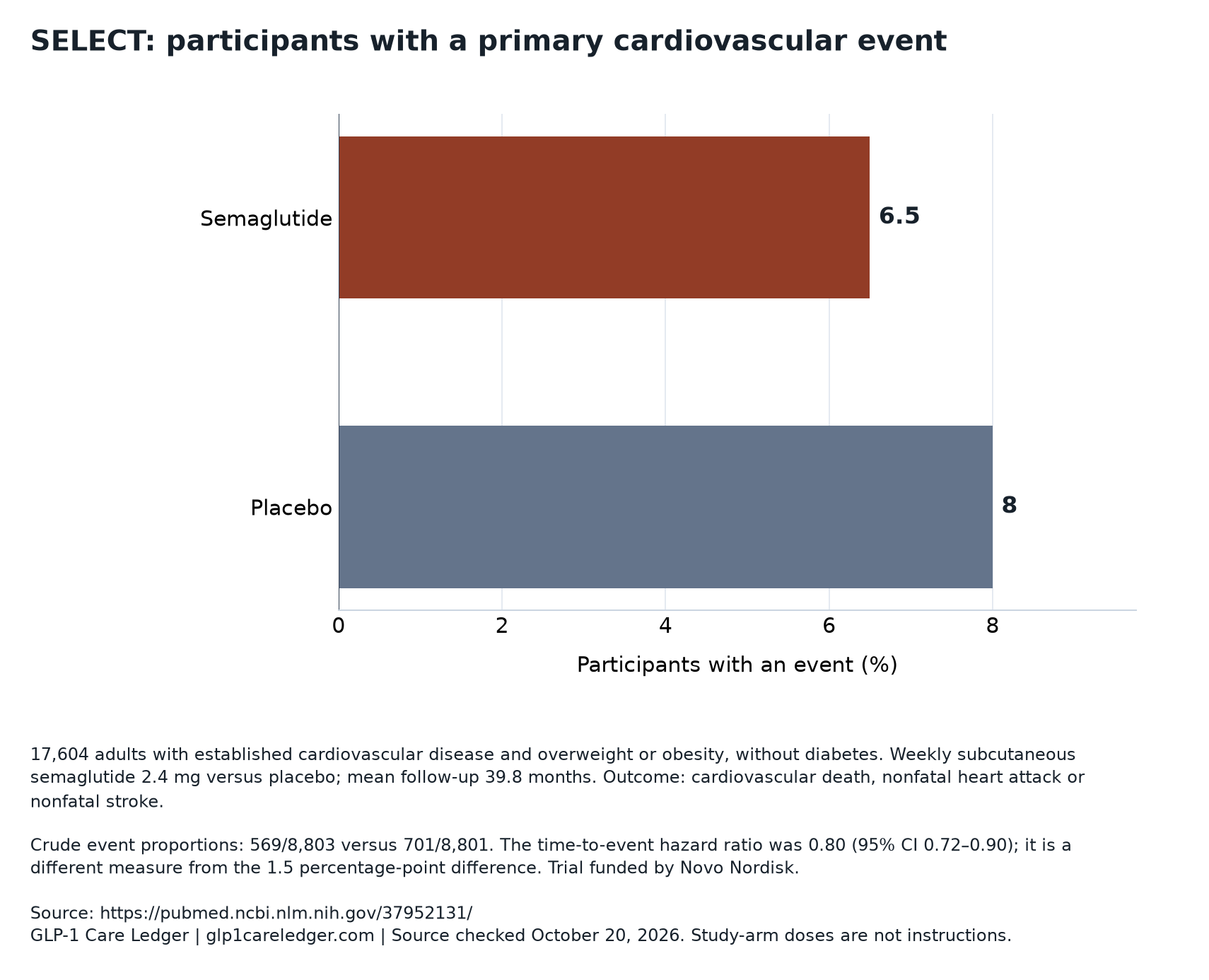
SELECT tested a question that a weight-loss result alone cannot answer: does weekly injectable semaglutide reduce serious cardiovascular events in people who already have cardiovascular disease but do not have diabetes? In 17,604 randomized participants, the answer favored semaglutide over placebo. The primary outcome combined cardiovascular death, nonfatal heart attack, and nonfatal stroke. Its hazard ratio was 0.80, while the observed event proportions were 6.5% and 8.0%. Those numbers describe different aspects of the result—not competing versions of the same percentage.
For readers weighing continuing treatment expenses, the study provides a clinical time horizon, not an economic forecast. Mean follow-up was 39.8 months, and adverse events caused more permanent treatment discontinuations with semaglutide. This analysis uses the indexed primary report abstracts and the supplied official FDA material; it does not represent an examination of complete trial protocols, supplements, or full texts. The central task is to separate what SELECT measured from assumptions about individual benefit, product equivalence, and affordability.
At a glance
- Who was studied
- SELECT enrolled 17,604 adults age 45 or older with preexisting cardiovascular disease, BMI of at least 27, and no history of diabetes.Sources: [1]
- Treatment and comparator
- Participants received once-weekly subcutaneous semaglutide, with a study dose of 2.4 mg, or placebo. Both groups also received standard cardiovascular care and lifestyle counseling.
- Primary cardiovascular result
- First primary events occurred in 569 of 8,803 semaglutide participants and 701 of 8,801 placebo participants: 6.5% versus 8.0%; hazard ratio 0.80, 95% confidence interval 0.72–0.90.Sources: [1]
- Time observed
- Mean follow-up was 39.8 months, compared with mean trial-product exposure of 34.2 months. These are distinct measures, not a guaranteed duration of benefit.Sources: [1]
- Discontinuation matters
- Adverse events led to permanent trial-product discontinuation in 16.6% of the semaglutide group and 8.2% of the placebo group.Sources: [1]
This was prevention after cardiovascular disease was already present
SELECT’s eligibility criteria define the result’s reach. Participants were at least 45 years old, had a body mass index of 27 or higher, and already had cardiovascular disease. BMI relates weight to height; it was an enrollment measure, not the cardiovascular outcome. A history of diabetes excluded participation. This combination allowed investigators to test cardiovascular benefit in a population not selected for diabetes treatment.
The distinction between secondary and primary prevention is essential. Secondary prevention aims to prevent further events in people with established disease. Primary prevention aims to prevent a first event in people without established disease. SELECT directly supports the former setting, not a promise of primary prevention for everyone with overweight or obesity. Its placebo group’s 8.0% observed event proportion describes the comparison group under this study’s care and observation. It is not a universal untreated risk, an annual rate, or a prediction for any particular reader.
Randomization tested an addition to cardiovascular care
SELECT was a multicenter, double-blind, randomized, placebo-controlled superiority trial. Investigators assigned 8,803 participants to semaglutide and 8,801 to placebo in a 1:1 ratio. Randomization makes the assigned groups more comparable than groups formed by personal treatment choice. Blinding limits ways that knowledge of treatment could influence care or reporting. A superiority design asks whether the intervention performs better than its comparator on the specified outcome.
The study intervention was once-weekly semaglutide injected under the skin, with a 2.4-mg study dose. That identifies the trial arm; it is not a dosing instruction. The FDA’s supplied announcement states that both groups received standard cardiovascular care and lifestyle counseling. Thus, the comparison was not semaglutide versus doing nothing. It tested the added effect of assignment to semaglutide against placebo within that care context. Novo Nordisk funded the trial. Sponsorship is relevant context, while the randomized design, outcome definition, and reported uncertainty remain the basis for interpreting its result.
STUDY DATA · GLP-1 Care Ledger
SELECT: participants with a primary cardiovascular event
17,604 adults with established cardiovascular disease and overweight or obesity, without diabetes. Weekly subcutaneous semaglutide 2.4 mg versus placebo; mean follow-up 39.8 months. Outcome: cardiovascular death, nonfatal heart attack or nonfatal stroke.
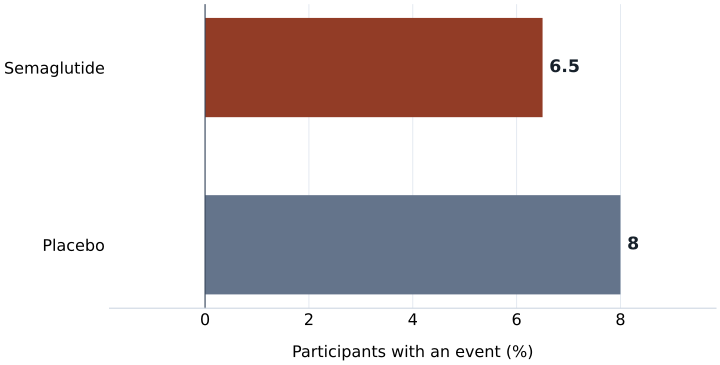
| Study group | Participants with an event (%) |
|---|---|
| Semaglutide | 6.5 |
| Placebo | 8 |
Crude event proportions: 569/8,803 versus 701/8,801. The time-to-event hazard ratio was 0.80 (95% CI 0.72–0.90); it is a different measure from the 1.5 percentage-point difference. Trial funded by Novo Nordisk.
Original visualization of published aggregate data. No individual prediction or provider performance is represented. Original research ↗
The three-part endpoint is not three separate promises
The primary endpoint combined death from cardiovascular causes, nonfatal myocardial infarction—commonly called a heart attack—and nonfatal stroke. Investigators analyzed time to the first qualifying event. A composite endpoint brings several clinically important events into one analysis. Time-to-first-event analysis considers when that first event occurs, rather than merely comparing totals at the end of observation.
That structure sets important boundaries. A participant who experiences more than one qualifying event does not contribute every event to the primary first-event count. The primary result therefore does not describe the total burden of recurrent cardiovascular events. Nor does a favorable composite establish that each component improved separately or by the same amount. The supplied SELECT abstract does not provide component-specific estimates. It supports a conclusion about the combined endpoint, not an independently demonstrated reduction in cardiovascular death, heart attack, and stroke considered one by one. It also does not establish, from this evidence alone, how much of the effect came through weight change or other biological pathways.
Reading 20% and 1.5 percentage points correctly
The hazard ratio was 0.80, with a 95% confidence interval of 0.72–0.90. Subtracting 0.80 from 1 produces the commonly reported 20% lower hazard. Hazard concerns the rate of a first event over time among participants who have not yet experienced it. This is not equivalent to saying that 20% of participants avoided an event. The confidence interval corresponds to a relative hazard reduction of approximately 10%–28%, under the statistical model.
The reported event proportions answer a simpler descriptive question: what fraction of each randomized group had a first primary event during observation? Those proportions were 6.5% and 8.0%. Subtracting the rounded values gives a 1.5-percentage-point crude difference—about 15 fewer participants with a first event per 1,000 randomized. That is a group-level description over the trial’s observation, not an annual benefit or individual forecast. It also lacks the time-to-event adjustment underlying the hazard ratio. Keeping both measures visible prevents a large-sounding relative figure from obscuring the absolute scale.
| Measure | Reported result or calculation | What it means |
|---|---|---|
| First-event counts | 569/8,803 versus 701/8,801 | Participants with a first primary event, not all recurrent events |
| Observed proportions | 6.5% versus 8.0% | Crude proportions during study observation |
| Crude percentage-point difference | 8.0% − 6.5% = 1.5 percentage points | Approximately 15 fewer first-event participants per 1,000, using rounded percentages |
| Hazard ratio | 0.80; 95% CI 0.72–0.90 | 20% lower estimated hazard; the analysis accounts for event timing |
Baseline risk changes what a relative result means
An absolute benefit depends partly on how often the outcome would occur without the added intervention. SELECT’s placebo event proportion arose in people with established cardiovascular disease who were receiving background care. That matters because a similar relative effect, even if demonstrated elsewhere, need not produce the same absolute difference in a lower-risk population. SELECT itself does not establish that the same relative effect applies outside its enrollment criteria.
The 95% confidence interval gives another dimension of uncertainty. It excludes a hazard ratio of 1, the value representing no difference, and the reported P value was below 0.001. These findings support a treatment difference in the primary analysis. They do not assign a 95% probability that any individual’s benefit lies within the interval, nor do they resolve every question about broader populations. A practical reading starts with population match and endpoint relevance before considering the headline percentage. Statistical precision within a trial cannot substitute for evidence in an unstudied population.
Follow-up and drug exposure ran on different clocks
Mean follow-up was 39.8 months, with a standard deviation of 9.4 months. Mean exposure to semaglutide or placebo was shorter: 34.2 months, with a standard deviation of 13.7 months. Follow-up is the observation period; exposure is time receiving the assigned trial product. Their difference shows why being observed in a trial should not be treated as synonymous with continuously taking treatment. The averages also do not mean that every participant had either duration.
SELECT was event-driven: its design centered on accumulating cardiovascular outcome information rather than interpreting a brief change on a scale. Its roughly three-year average observation supports a medium-term cardiovascular conclusion, not an unlimited lifetime projection. Editorial interpretation: a budget discussion should likewise distinguish the duration studied from the duration someone may ultimately pay for care. Neither 34.2 nor 39.8 months is a recommended purchase commitment. The billing-cycle guide helps separate payment intervals from calendar time, but no billing calculation can establish how long the clinical effect persists after treatment ends.
Discontinuation is a clinical result, not a footnote
Adverse events led to permanent discontinuation of the assigned product in 1,461 semaglutide participants, or 16.6%, compared with 718 placebo participants, or 8.2%. The difference between the reported percentages is 8.4 percentage points. This is a tolerability finding: substantially more participants stopped semaglutide permanently because of adverse events. It is not the overall frequency of adverse events, the serious-adverse-event rate, or a measure of discontinuation for every possible reason.
The supplied SELECT abstract does not break those adverse events into specific diagnoses or provide a complete safety profile. Consequently, it supports neither a blanket statement that treatment was safe nor a detailed attribution of the discontinuation difference to particular symptoms. Importantly, the discontinuation percentages and cardiovascular event percentages measure different outcomes; subtracting one from the other would not yield a valid net-benefit score. Editorial interpretation: tolerability also makes written cancellation terms relevant to financial planning. The cancellation and refunds guide and CoreAge Rx review can help readers inspect documentary terms, without implying that a provider offers the studied treatment or reproduces SELECT’s outcomes.
The regulatory finding belongs to a specific product and setting
The supplied FDA announcement, dated March 8, 2024, documents a cardiovascular indication for Wegovy semaglutide injection in adults with cardiovascular disease and overweight or obesity, alongside reduced-calorie diet and increased physical activity. This historical action helps connect the trial with a defined regulatory use. It is not a substitute for current complete prescribing information, and the trial report itself should not be used as a current prescribing reference.
Evidence also does not transfer automatically across routes, formulations, or sources. SELECT studied weekly subcutaneous semaglutide, not oral products or a provider’s care program. FDA states that compounded drugs are not approved or reviewed before marketing for safety, effectiveness, or quality, and identifies concerns including dosing errors and semaglutide salt ingredients. Those reports do not establish event rates or causation, but they undermine assumptions of automatic equivalence. The guide to compounded and approved-product pricing provides a framework for comparing unlike offers. Editorial interpretation: a cheaper quoted product cannot simply inherit SELECT’s cardiovascular evidence because its marketing uses the same ingredient name.
FLOW and SUMMIT answer different organ-outcome questions
FLOW studied 3,533 people with type 2 diabetes and chronic kidney disease, using weekly subcutaneous semaglutide at 1.0 mg versus placebo. Its primary composite included kidney failure, a large decline in kidney filtration, or kidney-related or cardiovascular death. Over a median 3.4 years, the hazard ratio was 0.76, with a 95% confidence interval of 0.66–0.88. The trial stopped early following a prespecified interim analysis. The FLOW analysis explains why this is kidney-outcome evidence in a diabetes population, not a replication of SELECT.
SUMMIT tested tirzepatide, a different drug, in 731 people with obesity and heart failure with preserved ejection fraction. Its cardiovascular-death-or-worsening-heart-failure composite favored tirzepatide, but cardiovascular deaths alone were numerically higher and imprecisely estimated: hazard ratio 1.58, 95% confidence interval 0.52–4.83. Discontinuations due to adverse events, mainly gastrointestinal, were 6.3% versus 1.4%. As the SUMMIT analysis explains, a favorable composite need not imply improvement in every component. Neither trial permits ranking products against SELECT by comparing headline hazard reductions across unlike populations and endpoints.
| Trial and population | Intervention and follow-up | Primary clinical outcome |
|---|---|---|
| SELECT: established cardiovascular disease, BMI ≥27, no diabetes | Semaglutide 2.4 mg weekly injection versus placebo; mean follow-up 39.8 months | Cardiovascular death, nonfatal heart attack, or nonfatal stroke; HR 0.80 (95% CI 0.72–0.90) |
| FLOW: type 2 diabetes and chronic kidney disease | Semaglutide 1.0 mg weekly injection versus placebo; median follow-up 3.4 years | Kidney-event/death composite; HR 0.76 (95% CI 0.66–0.88) |
| SUMMIT: obesity and heart failure with ejection fraction ≥50% | Tirzepatide up to 15 mg weekly injection versus placebo; median follow-up 104 weeks | Cardiovascular death or worsening heart failure; HR 0.62 (95% CI 0.41–0.95); health status was another primary endpoint |
A cardiovascular benefit is not a demonstrated financial return
The supplied SELECT evidence reports cardiovascular outcomes, exposure, follow-up, and adverse-event discontinuation. It does not report a cost-effectiveness analysis, household spending, insurance coverage, or net medical savings. Preventing serious events may have economic importance, but attaching a dollar return to the observed effect would require additional evidence about costs, timing, utilization, and whose perspective is being evaluated. A payer’s potential savings and a patient’s out-of-pocket affordability are different questions.
Editorial interpretation: evidence-informed budgeting should use the trial to identify what clinical claim is supported, then use actual written terms to understand the financial commitment. The budget workbook can organize those terms without turning an event reduction into guaranteed savings. Continuing access, follow-up charges, and cancellation obligations remain contract questions, not SELECT findings. A higher price does not demonstrate greater cardiovascular effectiveness, and a lower price does not establish equivalence to the studied product. Most importantly, the trial’s average duration should not be converted into a prepaid package recommendation or a promise that benefits survive any interruption.
Questions & answers
Does SELECT mean semaglutide prevents a first cardiovascular event in people without cardiovascular disease?
No. Participants already had cardiovascular disease, so this was a secondary-prevention population. The study does not establish primary-prevention benefit in people without established disease. Overweight or obesity alone does not make someone equivalent to SELECT’s participants, and their individual baseline risk cannot be inferred from its placebo event proportion.
Why not describe the result simply as a 20% risk reduction?
The precise reported estimate was a 20% lower hazard, based on time to a first primary event. The observed proportions were 6.5% versus 8.0%, a 1.5-percentage-point crude difference. Calling both figures risk reduction without explaining their denominators and time structure can make the absolute result seem much larger than it was.
Did SELECT prove that every component of the composite improved?
The indexed abstract does not provide component-specific estimates. Its positive primary result applies to cardiovascular death, nonfatal heart attack, or nonfatal stroke considered together. It does not independently demonstrate a reduction in each component, quantify recurrent events, or establish that every participant experienced benefit.
What does the study tell us about staying on treatment?
Mean treatment exposure was 34.2 months, shorter than mean follow-up of 39.8 months. Adverse events caused permanent product discontinuation in 16.6% with semaglutide versus 8.2% with placebo. These findings make tolerability relevant, but they do not specify an appropriate treatment duration or establish how protection changes after stopping.
Can a compounded product or a subscription claim SELECT’s results?
SELECT does not establish equivalent outcomes for compounded preparations, other formulations, oral routes, or provider programs. FDA notes that compounded drugs lack premarketing approval and review for safety, effectiveness, and quality. A subscription’s documentary terms can be evaluated separately, but neither its price nor its service structure demonstrates the cardiovascular benefit measured in SELECT.
Our assessment
SELECT provides strong randomized evidence that adding weekly injectable semaglutide reduced the hazard of a first major cardiovascular composite event in adults with established cardiovascular disease and overweight or obesity, without diabetes. The clinically useful reading keeps the 20% relative hazard reduction, the 1.5-percentage-point crude difference, and increased adverse-event discontinuation in view together. Editorial interpretation: the result can inform the value question, but it cannot answer the affordability question. Evidence-based budgeting requires separating demonstrated clinical outcomes from unmeasured savings, contractual commitments, and assumptions about continued access.
Sources & documentation
Scientific and official sources consulted October 20, 2026. Study findings apply to the populations, products and time periods described; they are not provider outcome data.
- Semaglutide and Cardiovascular Outcomes in Obesity without Diabetes. ↗
- FDA cardiovascular indication for Wegovy, March 8, 2024 ↗
- FDA concerns about unapproved GLP-1 drugs ↗
- Effects of Semaglutide on Chronic Kidney Disease in Patients with Type 2 Diabetes. ↗
- Tirzepatide for Heart Failure with Preserved Ejection Fraction and Obesity. ↗