FLOW addressed a consequential question beyond weight change: could semaglutide reduce major kidney disease events in people with type 2 diabetes and chronic kidney disease? Among 3,533 randomized participants, weekly injected semaglutide produced a lower rate of the primary composite outcome than placebo over a median 3.4 years. That composite included kidney failure, a large decline in kidney filtration, and death from kidney-related or cardiovascular causes. The result therefore concerns serious clinical outcomes, but it is not simply a count of dialysis cases avoided. [science-flow]
For evidence-informed budgeting, the distinction matters. A trial can establish a clinical benefit without establishing a household’s savings, insurance coverage, or affordable duration of treatment. This analysis uses the indexed primary report abstracts and the available official material; it does not represent a review of all full texts, protocols, or supplements. The strongest interpretation stays close to the studied population, the actual endpoint definitions, and the time observed—then labels any financial implications as editorial reasoning rather than trial findings. [science-flow; science-niddk]
At a glance
- Study population
- FLOW randomized 3,533 people with type 2 diabetes and chronic kidney disease defined by specific combinations of reduced eGFR and elevated urine albumin.Sources: [1]
- Intervention and comparator
- The study compared subcutaneous semaglutide 1.0 mg weekly with placebo; these doses identify the study arms, not personal treatment instructions.Sources: [1]
- Primary finding
- There were 331 versus 410 first primary-outcome events; the hazard ratio was 0.76, with a 95% confidence interval of 0.66–0.88.Sources: [1]
- Duration and stopping
- Median follow-up was 3.4 years, after early trial cessation was recommended at a prespecified interim analysis.Sources: [1]
- Safety finding
- Serious adverse events were reported in 49.6% of semaglutide participants and 53.8% of placebo participants; this is not a complete description of tolerability.Sources: [1]
FLOW enrolled a defined kidney-risk population
Eligibility required both type 2 diabetes and chronic kidney disease meeting one of two laboratory patterns. Estimated glomerular filtration rate, or eGFR, estimates how much blood the kidneys filter; it is standardized to a body surface area of 1.73 square meters. Urinary albumin-to-creatinine ratio, or UACR, measures albumin in urine relative to creatinine. Albumin leakage and reduced filtration describe related but different aspects of kidney disease.
People with eGFR from 50 to 75 needed UACR above 300 and below 5,000 mg/g. Those with eGFR from 25 to below 50 needed UACR above 100 and below 5,000 mg/g. Thus, the lower-filtration group could enter with a lower albumin threshold. These were paired criteria, not independent alternatives allowing anyone with diabetes or an abnormal kidney test to qualify.
That structure limits generalization. The trial did not represent every person with early kidney disease, everyone with diabetes, or everyone seeking obesity treatment. In particular, the reported entry criteria do not establish the same benefit in people with normal albumin excretion or without diabetes.
| Eligibility pathway | eGFR, mL/min/1.73 m² | UACR, mg/g |
|---|---|---|
| Higher-filtration pathway | 50–75 | Greater than 300 and less than 5,000 |
| Lower-filtration pathway | 25 to less than 50 | Greater than 100 and less than 5,000 |
Randomization tested an injected treatment against placebo
FLOW assigned 1,767 participants to subcutaneous semaglutide 1.0 mg weekly and 1,766 to placebo. Random assignment makes the treatment comparison more informative than comparing people who independently chose different medicines: it reduces the likelihood that baseline health differences explain the result. The trial was funded by Novo Nordisk and registered as NCT03819153.
The dose and injection route identify the intervention studied. They do not establish equivalent kidney outcomes for oral semaglutide, other doses, different medicines, or compounded preparations. Nor does the comparison tell readers which commercial care arrangement provides equivalent monitoring or access.
The indexed abstract does not provide the full background-treatment regimen, adherence history, or detailed eligibility exclusions. Those missing details matter when evaluating how closely a particular care setting resembles the study. Randomization supports the internal comparison; it does not erase questions about application outside the enrolled population.
STUDY DATA · GLP-1 Care Ledger
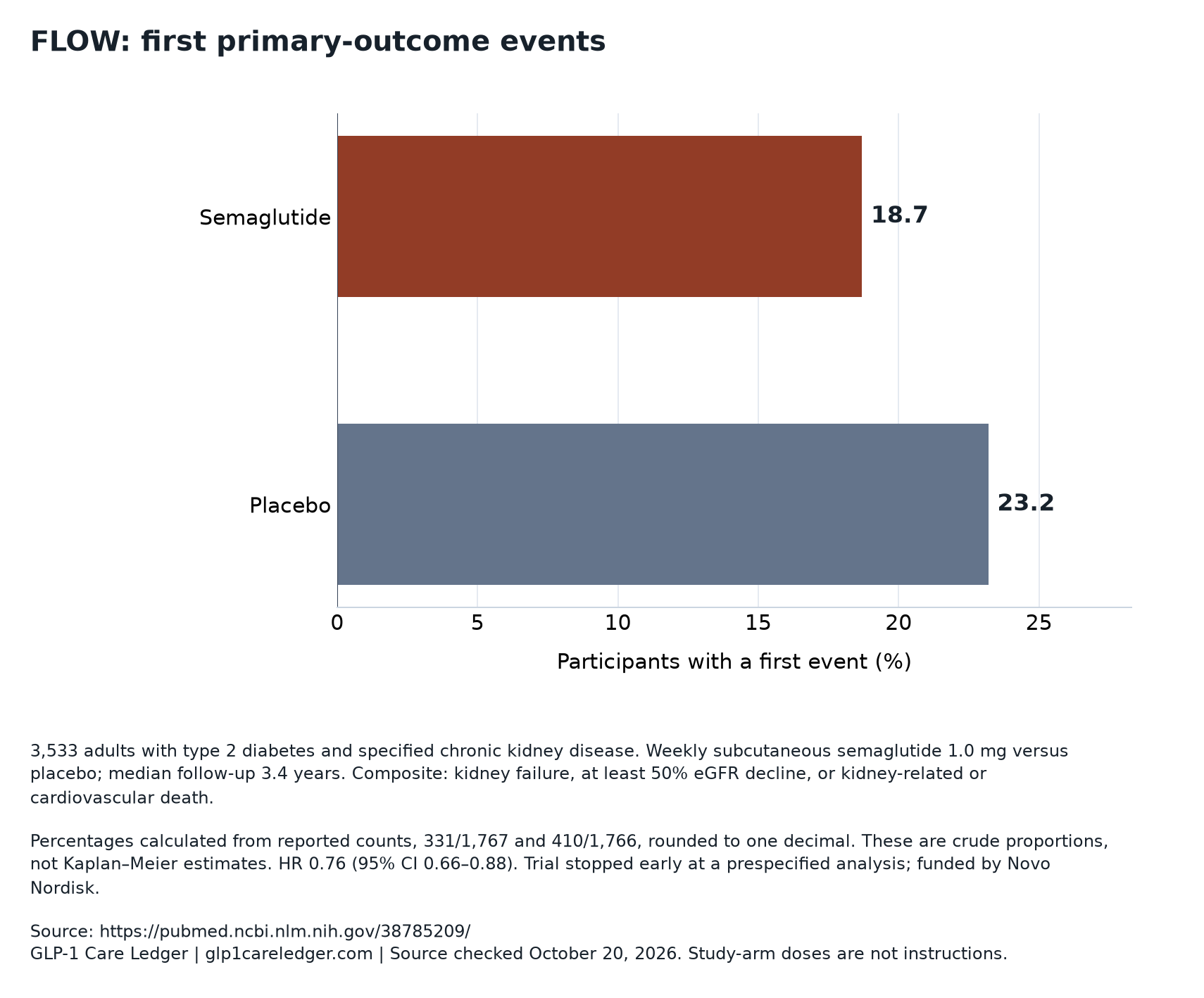
FLOW: first primary-outcome events
3,533 adults with type 2 diabetes and specified chronic kidney disease. Weekly subcutaneous semaglutide 1.0 mg versus placebo; median follow-up 3.4 years. Composite: kidney failure, at least 50% eGFR decline, or kidney-related or cardiovascular death.
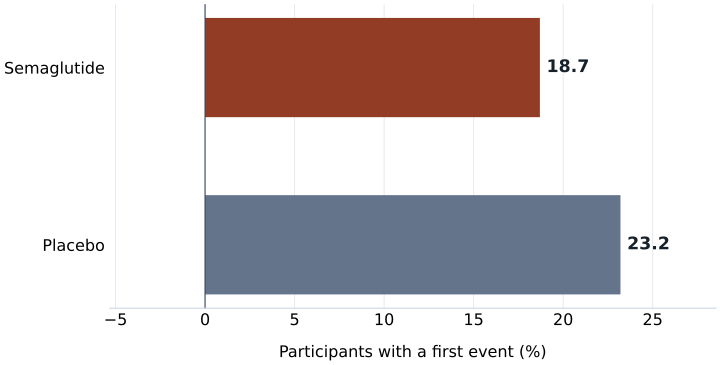
| Study group | Participants with a first event (%) |
|---|---|
| Semaglutide | 18.7 |
| Placebo | 23.2 |
Percentages calculated from reported counts, 331/1,767 and 410/1,766, rounded to one decimal. These are crude proportions, not Kaplan–Meier estimates. HR 0.76 (95% CI 0.66–0.88). Trial stopped early at a prespecified analysis; funded by Novo Nordisk.
Original visualization of published aggregate data. No individual prediction or provider performance is represented. Original research ↗
The primary endpoint combined kidney events and cardiovascular death
FLOW’s primary outcome was a composite: the first occurrence of one of several qualifying events counted. Kidney failure included dialysis, transplantation, or eGFR below 15 mL/min/1.73 m². Other qualifying events were at least a 50% reduction in eGFR from baseline or death from kidney-related or cardiovascular causes.
Combining events gives a broader measure of serious disease burden. However, cardiovascular death is not the same event as kidney failure, and a large filtration decline is not identical to starting dialysis. A favorable composite result cannot establish that every component improved individually.
The report also supplied a kidney-specific composite excluding cardiovascular death, which helps address whether the headline finding depended entirely on cardiovascular mortality. Its hazard ratio favored semaglutide, but the abstract does not provide separate estimates for every kidney component. Claims about dialysis alone would therefore go beyond this evidence.
| Measure | Reported result | Interpretive boundary |
|---|---|---|
| Primary composite | HR 0.76; 95% CI 0.66–0.88 | Combines major kidney events with kidney-related or cardiovascular death |
| Kidney-specific composite | HR 0.79; 95% CI 0.66–0.94 | Supports a kidney-specific benefit, not an isolated dialysis estimate |
| Annual eGFR slope | 1.16 mL/min/1.73 m² less decline per year | Describes average filtration trajectory, not a count of kidney-failure events |
A 24% lower hazard is not a 24-point reduction
The primary analysis recorded 331 first events in the semaglutide group and 410 in the placebo group. The hazard ratio was 0.76, with a 95% confidence interval of 0.66–0.88. This is commonly summarized as a 24% lower relative hazard during follow-up. A hazard ratio compares event occurrence over time; it is not a direct statement that 24 fewer people out of every 100 had an event.
Simple division provides a useful, explicitly crude perspective: 331 divided by 1,767 is approximately 18.7%, while 410 divided by 1,766 is approximately 23.2%. The difference is about 4.5 percentage points. These fractions do not adjust for differing observation times or censoring, so they should not replace the trial’s time-to-event analysis.
The confidence interval indicates uncertainty around the relative estimate, ranging from a hazard ratio of 0.66 to 0.88. It does not predict a particular person’s benefit. Absolute benefit depends on the underlying event risk, which is one reason these results cannot be transferred unchanged to a lower-risk population.
Kidney-specific events and deaths provide complementary evidence
For the kidney-specific components of the primary endpoint, the hazard ratio was 0.79, with a 95% confidence interval of 0.66–0.94. This supports the conclusion that the overall finding was not solely a cardiovascular-death result. Nevertheless, it remains a composite measure and does not identify how much each kidney event contributed.
Death from cardiovascular causes had a hazard ratio of 0.71, with a 95% confidence interval of 0.56–0.89. Because cardiovascular death was already part of the primary composite, this is an overlapping analysis, not a wholly separate set of additional benefits to add to the primary result.
That overlap is scientifically important. One participant’s cardiovascular death can contribute to both the primary analysis and the cardiovascular-death analysis. Summing relative reductions across these outcomes would double-count evidence and create a misleading picture of the total benefit.
Filtration slope and the secondary testing sequence
The mean annual eGFR decline was less steep with semaglutide by 1.16 mL/min/1.73 m² per year. This slope result describes the average pace of filtration loss across participants. It is distinct from crossing a kidney-failure threshold and can capture differences before that threshold is reached.
It would be inappropriate to turn this average slope difference into a guaranteed number of dialysis-free years. Individual trajectories vary, and the abstract does not establish a constant lifelong treatment effect. A slower mean decline also does not mean every participant’s eGFR improved.
Prespecified confirmatory secondary outcomes were tested hierarchically—within an ordered testing framework rather than as an unrestricted collection of findings. All favored semaglutide: eGFR slope, major cardiovascular events, and death from any cause. The cardiovascular-event hazard ratio was 0.82 (95% CI, 0.68–0.98), and the all-cause mortality hazard ratio was 0.80 (95% CI, 0.67–0.95). The abstract does not provide the complete statistical testing plan.
Early stopping sets a boundary on long-term inference
Median follow-up was 3.4 years, and early cessation was recommended at a prespecified interim analysis. Prespecification matters because it indicates that an interim assessment was planned rather than improvised after noticing a favorable result. The indexed abstract does not describe the full stopping boundary or the planned follow-up that would otherwise have occurred.
Early stopping does not invalidate the randomized comparison, but it limits observation of later events. It can also make the estimated treatment effect sensitive to when the stopping threshold was crossed. The confidence intervals quantify uncertainty in the reported analyses; they do not answer every question about persistence over longer periods.
FLOW therefore supports benefit during the observed study period, not a lifetime guarantee or a minimum treatment duration after which benefit is secured. For a separate discussion of withdrawal-study design, see SURMOUNT-4 and randomized withdrawal; that article addresses a different question and should not substitute for FLOW’s kidney evidence.
Serious adverse events are important—but not the whole safety picture
Serious adverse events were reported in 49.6% of semaglutide participants and 53.8% of placebo participants, a difference of 4.2 percentage points. This is a real safety finding in the enrolled population. It does not show that semaglutide caused every difference between groups, and a serious-event category is not a complete inventory of side effects.
The supplied FLOW abstract does not report detailed gastrointestinal adverse-event rates or treatment discontinuation rates. Those omissions prevent a balanced numerical account of everyday tolerability from this source alone. Fewer serious events overall should not be translated into a blanket claim that treatment was harmless or easy for everyone to continue.
The January 2025 FDA Ozempic label supplied here documents an indication covering sustained eGFR decline, end-stage kidney disease, and cardiovascular death in adults with type 2 diabetes and chronic kidney disease. It supports that historical approval, not a claim that this is the latest complete label. Trial reports and this label excerpt are not substitutes for current prescribing information.
FLOW and SELECT answer different clinical questions
SELECT enrolled 17,604 adults aged 45 or older with established cardiovascular disease, BMI of at least 27, and no history of diabetes. It compared weekly subcutaneous semaglutide 2.4 mg with placebo. Its primary endpoint was cardiovascular death, nonfatal heart attack, or nonfatal stroke—not FLOW’s kidney-centered composite.
SELECT reported primary events in 6.5% versus 8.0%, with a hazard ratio of 0.80 (95% CI, 0.72–0.90), over a mean 39.8 months of follow-up. Permanent treatment discontinuation because of adverse events occurred in 16.6% versus 8.2%. These figures belong to SELECT; they cannot fill gaps in FLOW’s safety reporting. Both trials were funded by Novo Nordisk.
The SELECT cardiovascular-outcomes analysis provides a separate setting for interpreting that evidence. Together, the studies show why the medicine’s name alone is insufficient: population, dose, endpoint, and follow-up define what was tested. Neither trial establishes the same outcomes for everyone using a GLP-1 medicine for weight management.
Budgeting should match the evidence without claiming savings
Editorial interpretation: FLOW provides a clinical reason to take continuity and follow-up seriously when evaluating affordability, but it does not price either one. The supplied report contains no household-cost analysis, insurance guarantee, or demonstrated dollar savings from avoided events. Its median follow-up is an observation period, not a subscription term or a forecast of how long someone will pay.
A practical financial comparison can separate recurring medication and service charges from other care expenses using a written-quote budget and a follow-up care cost review. NIDDK notes that cost, benefit, tolerability, and coverage matter in weight-management medication decisions. That general resource does not establish kidney-specific eligibility or a personal continuation plan.
Price also cannot establish product equivalence. FDA states that compounded drugs are not FDA approved or reviewed before marketing for safety, effectiveness, or quality, and identifies dosing-error and semaglutide-salt concerns. The approved-versus-compounded pricing guide separates price comparison from evidence transfer. For documentary terms only, the Ro review can help frame questions about written charges; it does not establish access to the studied product, kidney care, or FLOW-like outcomes.
Questions & answers
Did FLOW prove that semaglutide prevents dialysis?
FLOW found fewer events in a composite that included dialysis, transplantation, very low eGFR, a large eGFR decline, and kidney-related or cardiovascular death. A kidney-specific composite also favored semaglutide. However, the indexed abstract does not report a separate dialysis estimate. The defensible conclusion concerns the reported composites, not a guaranteed or individually quantified prevention of dialysis.
Does the result apply to chronic kidney disease without diabetes?
That population was not the population described in FLOW. Participants had type 2 diabetes and met specific eGFR and albuminuria criteria. The trial does not establish the same effect in people without diabetes, people with normal urine albumin, or everyone with reduced kidney function. Answering those questions requires evidence directly addressing those populations.
Why does cardiovascular death appear in a kidney trial?
The investigators defined the primary outcome to include cardiovascular death alongside major kidney events and kidney-related death. This makes the endpoint broader than kidney failure alone. Reporting the kidney-specific composite and cardiovascular-death result separately helps readers understand that breadth, but those overlapping analyses should not be added together as independent benefits.
Does 3.4 years tell us when treatment can stop?
No. That was the median follow-up, not a randomized comparison of stopping at 3.4 years versus continuing. FLOW’s indexed abstract does not establish what happens to kidney protection after withdrawal. NIDDK’s general resource discusses duration in relation to benefit and tolerability, but it cannot supply a kidney-specific stopping rule missing from this trial.
Can a cheaper compounded product be assumed to deliver the same kidney benefit?
No. FLOW tested a specified injected semaglutide regimen, not every preparation sold under the ingredient’s name. FDA states that compounded products are not approved or reviewed before marketing for safety, effectiveness, or quality. Lower price does not demonstrate equivalent formulation, exposure, or clinical outcomes, and adverse-event reports about compounded products cannot by themselves establish event rates or causation.
Our assessment
FLOW provides persuasive randomized evidence of fewer major kidney-related events or cardiovascular deaths in a defined population with type 2 diabetes and albuminuric chronic kidney disease. The kidney-specific composite, slower average eGFR decline, and favorable confirmatory secondary outcomes strengthen the interpretation beyond a single headline statistic. Remaining questions concern individual components, detailed tolerability, longer-term effects, and applicability outside the entry criteria. Editorially, these findings justify distinguishing meaningful clinical evidence from price advertising—but they do not establish personal affordability, net savings, or equivalence across products and providers. [science-flow; science-fda-compounded]
Sources & documentation
Scientific and official sources consulted October 20, 2026. Study findings apply to the populations, products and time periods described; they are not provider outcome data.
- Effects of Semaglutide on Chronic Kidney Disease in Patients with Type 2 Diabetes. ↗
- FDA Ozempic prescribing information, January 2025 kidney indication ↗
- Semaglutide and Cardiovascular Outcomes in Obesity without Diabetes. ↗
- NIDDK prescription medications for overweight and obesity ↗
- FDA concerns about unapproved GLP-1 drugs ↗