SUMMIT offers an important answer to a specific question: among people with obesity and heart failure with preserved ejection fraction, did assignment to tirzepatide reduce cardiovascular death or worsening heart failure compared with placebo? The combined outcome occurred less often with tirzepatide. But its components tell different stories, and the trial’s roughly two-year observation period should not be confused with a guaranteed treatment duration, a survival benefit, or a financial payback period.
For readers weighing evidence alongside ongoing costs, the useful approach is to separate three things: what investigators measured, how confidently the results can be interpreted, and what a household budget still needs to establish independently. This analysis uses the indexed primary report abstracts for SUMMIT and two related trials, plus the available official FDA material. It does not represent a review of the full trial protocols, supplements, or complete articles.
At a glance
- Population and comparison
- SUMMIT randomized 731 people with heart failure, ejection fraction of at least 50%, and BMI of at least 30 to weekly subcutaneous tirzepatide, up to 15 mg, or placebo.Sources: [1]
- Observation period
- Treatment was planned for at least 52 weeks; median follow-up was 104 weeks. The health-status primary endpoint was assessed at 52 weeks.Sources: [1]
- Combined cardiovascular outcome
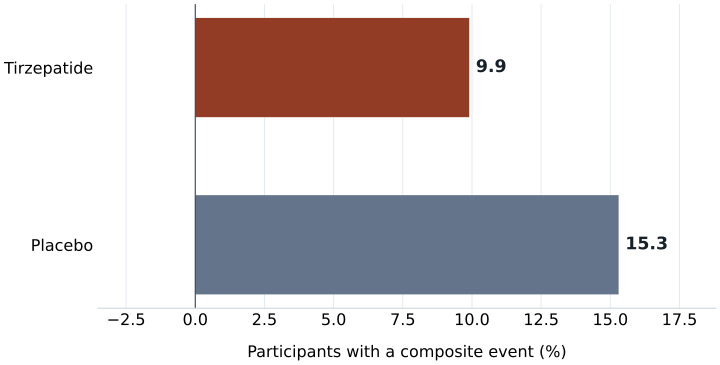
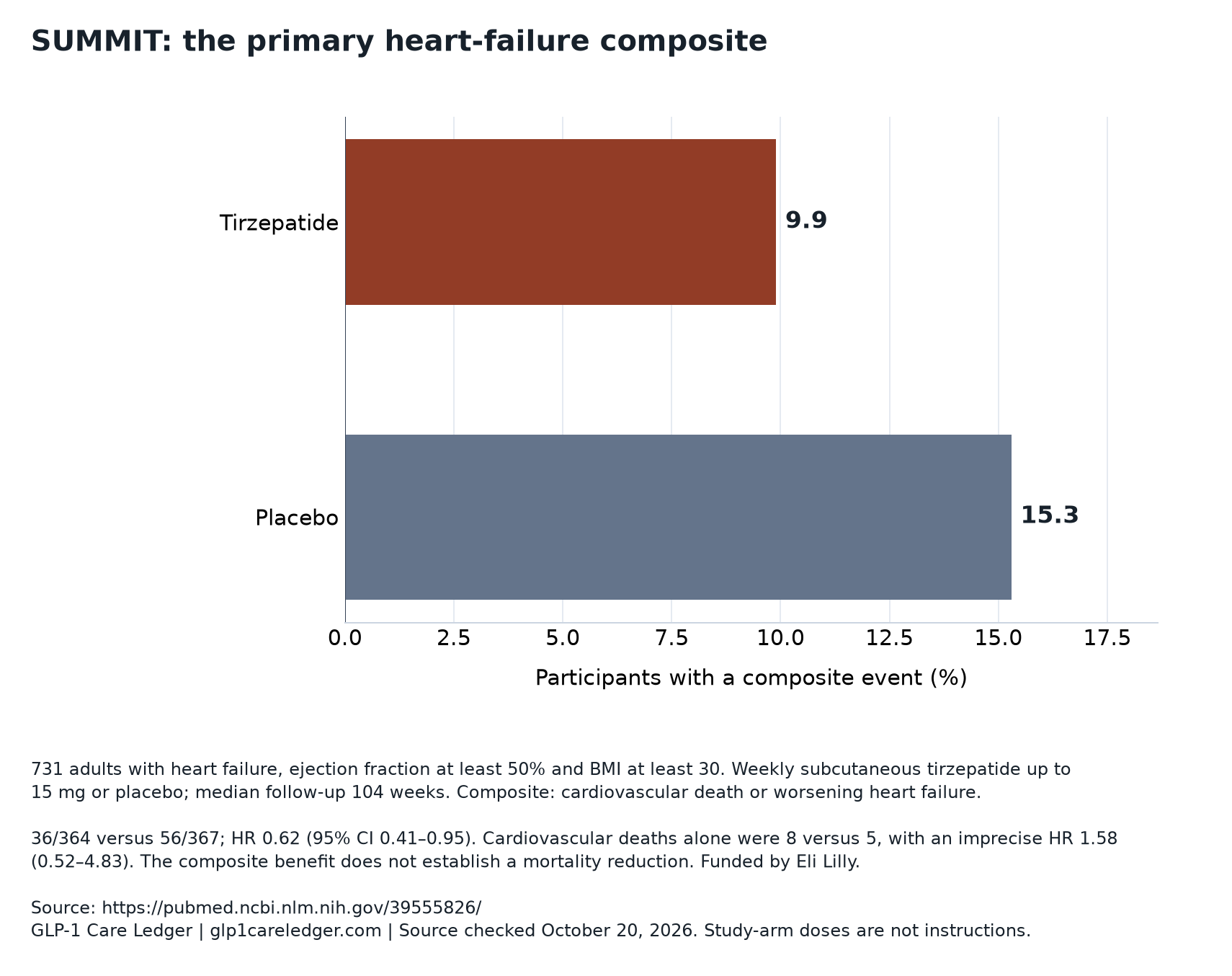
- Cardiovascular death or worsening heart failure occurred in 9.9% versus 15.3%; hazard ratio 0.62, with a 95% confidence interval of 0.41–0.95.Sources: [1]
- Mortality remains unresolved
- Cardiovascular deaths numbered 8 versus 5; hazard ratio 1.58, with a wide 95% confidence interval of 0.52–4.83. SUMMIT did not establish an isolated cardiovascular mortality benefit.Sources: [1]
- Discontinuation because of adverse events
- Adverse events, mainly gastrointestinal, led to trial-drug discontinuation in 23 tirzepatide participants (6.3%) and 5 placebo participants (1.4%).Sources: [1]
The population defines the reach of the finding
Heart failure with preserved ejection fraction, or HFpEF, is not a contradiction. Ejection fraction describes the proportion of blood in the heart’s main pumping chamber expelled with each beat. A preserved percentage does not rule out heart failure. SUMMIT required an ejection fraction of at least 50%, alongside heart failure and a body-mass index of at least 30.
Those entry criteria matter because this was not a general weight-loss trial or a study of everyone with cardiovascular disease. Its 731 participants had both obesity and this particular heart-failure phenotype. The evidence does not automatically extend to people with lower ejection fractions, people without heart failure, or people outside the studied BMI range.
The indexed abstract does not provide the detailed distribution of ages, accompanying illnesses, background therapies, or baseline symptom severity. Consequently, it supports a population-level conclusion but not a claim that any particular subgroup benefited equally. It also does not establish which clinical characteristics identify the strongest responders.
What randomization tested—and what 104 weeks means
SUMMIT was an international, double-blind, randomized, placebo-controlled trial. Investigators assigned 364 participants to tirzepatide and 367 to placebo in a 1:1 ratio. Randomization strengthens the comparison by reducing systematic differences between groups; blinding helps limit differences in expectations and assessment. Cardiovascular deaths and worsening heart-failure events were adjudicated, meaning they underwent a formal endpoint review.
The study intervention was subcutaneous tirzepatide once weekly, at doses up to 15 mg. These details identify the studied arm, not instructions for use. Tirzepatide acts at glucose-dependent insulinotropic polypeptide and glucagon-like peptide-1 receptors. That pharmacology identifies the drug, but does not by itself explain which biological pathway produced the clinical findings.
Participants were assigned treatment for at least 52 weeks, and median follow-up was 104 weeks. A median is the midpoint of observed follow-up, not a statement that everyone was observed for exactly two years. Nor does follow-up necessarily equal uninterrupted drug exposure. The abstract does not supply enough treatment-persistence information to equate the observation period with continuous use for every participant.
STUDY DATA · GLP-1 Care Ledger
SUMMIT: the primary heart-failure composite
731 adults with heart failure, ejection fraction at least 50% and BMI at least 30. Weekly subcutaneous tirzepatide up to 15 mg or placebo; median follow-up 104 weeks. Composite: cardiovascular death or worsening heart failure.
| Study group | Participants with a composite event (%) |
|---|---|
| Tirzepatide | 9.9 |
| Placebo | 15.3 |
36/364 versus 56/367; HR 0.62 (95% CI 0.41–0.95). Cardiovascular deaths alone were 8 versus 5, with an imprecise HR 1.58 (0.52–4.83). The composite benefit does not establish a mortality reduction. Funded by Eli Lilly.
Original visualization of published aggregate data. No individual prediction or provider performance is represented. Original research ↗
Two primary endpoints answered different questions
The first primary endpoint combined adjudicated cardiovascular death with a worsening heart-failure event, analyzed as time to the first qualifying event. This asks whether participants reached either outcome sooner or more often over follow-up. It does not count every repeated worsening episode, and it does not give death and worsening heart failure separate treatment-effect estimates within the primary result.
The other primary endpoint was change from baseline to 52 weeks in the Kansas City Cardiomyopathy Questionnaire clinical summary score, abbreviated KCCQ-CSS. This 0-to-100 measure captures health status, with higher scores representing better status. An event endpoint and a patient-reported endpoint can provide complementary evidence: one addresses serious clinical deterioration, while the other addresses how participants experience their illness.
Their measurement windows also differ. The health-status comparison is anchored at one year, whereas the event analysis reflects variable follow-up with a median of two years. Neither should be relabeled as an indefinite benefit. Reading them together provides a broader picture than treating either as a substitute for the other.
| Measure | Reported result | What it supports |
|---|---|---|
| Cardiovascular death or worsening heart failure | 36/364 (9.9%) vs 56/367 (15.3%); HR 0.62, 95% CI 0.41–0.95 | A lower hazard of the first combined event |
| Worsening heart failure | 29 (8.0%) vs 52 (14.2%); HR 0.54, 95% CI 0.34–0.85 | Fewer participants with worsening events |
| Cardiovascular death | 8 (2.2%) vs 5 (1.4%); HR 1.58, 95% CI 0.52–4.83 | No established isolated mortality benefit |
| KCCQ-CSS change at 52 weeks | 19.5 vs 12.7 points; reported difference 6.9, 95% CI 3.3–10.6 | Greater average health-status improvement |
Reading 9.9% versus 15.3% without changing the statistic
The combined endpoint occurred in 36 tirzepatide participants and 56 placebo participants. Subtracting the reported proportions gives an observed difference of 5.4 percentage points: 15.3% minus 9.9%. This is a descriptive difference between the proportions observed during the trial. It is not a 5.4% relative reduction, nor a standardized two-year risk estimate for every participant.
The hazard ratio was 0.62, with a 95% confidence interval of 0.41–0.95. A hazard compares the rate of reaching a first event among participants who have not yet had one. Thus, 0.62 is commonly described as a 38% lower hazard, not proof that each person’s probability fell by 38%. Dividing the crude percentages answers a different statistical question.
The confidence interval excludes 1, supporting a lower combined-event hazard under the trial analysis, but its breadth still matters. The data are compatible with a comparatively large benefit or one much closer to no difference. Only 92 participants reached the combined endpoint, so the study offers less precision than its percentage headline might suggest.
The components explain why this is not a survival claim
Worsening heart-failure events occurred in 29 participants receiving tirzepatide and 52 receiving placebo: 8.0% versus 14.2%. The hazard ratio was 0.54, with a 95% confidence interval of 0.34–0.85. This result points in the same favorable direction as the combined endpoint and provides the clearest component-level evidence behind the overall finding.
Cardiovascular deaths went in the opposite numerical direction: 8 with tirzepatide and 5 with placebo, or 2.2% versus 1.4%. The corresponding hazard ratio was 1.58, with a 95% confidence interval of 0.52–4.83. With only 13 cardiovascular deaths, that estimate is highly uncertain. It neither establishes a mortality benefit nor reliably establishes increased cardiovascular mortality.
The component counts cannot simply be added to reconstruct the composite. In the tirzepatide group, 29 plus 8 equals 37, yet 36 people reached the composite; in the placebo group, 52 plus 5 equals 57, yet the composite count was 56. The categories overlap, whereas the primary analysis counts a participant’s first qualifying event. This illustrates why fewer composite events do not mean every component improved.
Better reported health status, not a guarantee for every participant
At 52 weeks, mean KCCQ-CSS improvement was 19.5 points with tirzepatide and 12.7 points with placebo. Both groups therefore improved on average. The relevant treatment comparison is not the entire 19.5-point change, because some improvement also occurred in the comparator group. The report’s between-group estimate was 6.9 points, with a 95% confidence interval of 3.3–10.6.
Subtracting the displayed means yields 6.8 rather than 6.9. The abstract does not explain that small discrepancy; rounded displayed values need not reproduce a reported analysis estimate exactly. The appropriate result to retain is the reported between-group difference rather than replacing it with arithmetic on rounded figures.
An average difference does not show how many participants experienced substantial improvement, no improvement, or deterioration. Those response distributions are absent from the indexed abstract. Likewise, SUMMIT’s abstract does not provide a weight-change result or a mediation analysis establishing whether weight loss caused the heart-failure benefit. The clinical findings are stronger than any specific mechanistic explanation available here.
Tolerability is part of the result, not a footnote
Adverse events leading to trial-drug discontinuation occurred in 23 participants receiving tirzepatide and 5 receiving placebo. The reported proportions were 6.3% and 1.4%, an observed difference of 4.9 percentage points. These events were mainly gastrointestinal. This is concrete evidence of a tolerability burden, even alongside favorable efficacy results.
That discontinuation measure is narrower than the incidence of all adverse events. It does not tell us how many people had milder symptoms, which gastrointestinal problems predominated, or the frequency of every serious safety outcome. The indexed abstract therefore cannot support a blanket statement that treatment was safe, nor a complete adverse-effect profile.
Discontinuation also creates a practical question the abstract cannot resolve: how do benefits, symptoms, and treatment persistence interact over longer periods? A participant assigned to a trial arm is not necessarily a participant who tolerates uninterrupted treatment indefinitely. For budgeting purposes, that uncertainty argues against assuming either permanent continuation or a predictable stopping date from these results alone.
Related trials add context, not a head-to-head ranking
STEP-HFpEF randomized 529 people with HFpEF and BMI of at least 30 to weekly semaglutide 2.4 mg or placebo for 52 weeks. Its primary endpoints were health-status change and weight change, not SUMMIT’s event composite. The reported KCCQ-CSS difference was 7.8 points, with a 95% confidence interval of 4.8–10.9; the weight-change difference was −10.7 percentage points, with a confidence interval of −11.9 to −9.4.
That trial also reported a 20.3-meter between-group improvement in six-minute walk distance, with a 95% confidence interval of 8.6–32.1. Serious adverse events occurred in 13.3% versus 26.7%. Those are different safety measurements from SUMMIT’s adverse-event discontinuations. The STEP-HFpEF analysis explains its symptom-and-function emphasis; similar score improvements across separate trials do not establish equivalence between drugs.
SELECT addressed another population: 17,604 people aged at least 45 with established cardiovascular disease, BMI of at least 27, and no diabetes history. Its semaglutide comparison concerned cardiovascular death, nonfatal heart attack, or nonfatal stroke. As the SELECT analysis discusses, a cardiovascular composite must be interpreted according to its actual components, not borrowed as confirmation of a different trial’s mortality result.
| Trial | Population and duration | Main outcome emphasis |
|---|---|---|
| SUMMIT; funded by Eli Lilly | 731 participants with HFpEF, EF ≥50%, BMI ≥30; median follow-up 104 weeks | Cardiovascular death or worsening heart failure; 52-week health status |
| STEP-HFpEF; funded by Novo Nordisk | 529 participants with HFpEF and BMI ≥30; 52 weeks | Health status and body weight |
| SELECT; funded by Novo Nordisk | 17,604 participants with established cardiovascular disease, BMI ≥27, no diabetes history; mean follow-up 39.8 months | Cardiovascular death, nonfatal heart attack, or nonfatal stroke |
Clinical duration is not a financial break-even calculation
Editorial interpretation: SUMMIT supplies no economic analysis in the available abstract. It does not report medication prices, household expenses, insurance coverage, medical spending avoided, or cost per health outcome. Fewer worsening events could matter economically, but translating that possibility into savings requires information this source does not provide. The trial cannot establish that treatment pays for itself.
The 104-week median follow-up is useful as an evidence horizon, not a purchase recommendation. A budget must separately identify recurring charges, what follow-up includes, and how prices change. The billing-cycle guide helps distinguish payment intervals, while the budget workbook organizes a written quote. Neither calculation can turn trial follow-up into a known lifetime treatment cost.
Contract questions also remain independent of efficacy. The cancellation and refunds guide can help identify documentary terms if care becomes unaffordable or treatment changes. A Ro review can likewise be used to check documented membership and payment terms; that reference does not establish access to the studied product, heart-failure care, or SUMMIT-like outcomes.
Product identity and missing evidence limit the translation
SUMMIT studied a defined injectable tirzepatide intervention, not a provider business model, an oral version, or interchangeable preparations. The FDA material states that compounded drugs are not FDA approved or reviewed before marketing for safety, effectiveness, or quality. Clinical results for a studied product do not establish equivalence for compounded preparations.
The FDA also identifies dosing errors and problems involving semaglutide salt ingredients among its concerns about unapproved GLP-1 drugs. Those reports cannot establish event rates or causation, and semaglutide-specific ingredient concerns should not be rewritten as findings from SUMMIT. The compounded-pricing guide provides a framework for keeping product evidence separate from price comparisons.
Important scientific questions remain: how durable are the event and health-status benefits beyond observed follow-up, which participants benefit most, and what explains the effect? The indexed report identifies Eli Lilly as SUMMIT’s funder. Sponsorship is relevant context, but the more immediate interpretive constraints here are sparse mortality events and the absence of full methods, detailed safety data, and economic outcomes in the indexed abstract.
Questions & answers
Did SUMMIT show that tirzepatide prevents cardiovascular death?
No isolated cardiovascular mortality benefit was established. There were 8 cardiovascular deaths with tirzepatide and 5 with placebo. The hazard-ratio confidence interval, 0.52–4.83, was too wide for a firm directional conclusion. The favorable primary result concerned cardiovascular death or worsening heart failure combined, with the clearer component benefit in worsening heart failure.
Why does the composite count differ from the sum of its components?
A participant can experience worsening heart failure and later die from a cardiovascular cause. Component categories can therefore overlap. The primary time-to-first-event analysis counts that participant once, at the first qualifying event, rather than adding both experiences as separate people.
Does median follow-up of 104 weeks mean treatment is needed for exactly two years?
No. It describes the midpoint of observed follow-up, not an established optimal treatment course. Treatment assignment was for at least 52 weeks. The abstract does not establish a stopping schedule, lifelong requirements, or how much benefit remains after treatment ends.
Can SUMMIT be used to choose tirzepatide over semaglutide?
Not as a direct comparative efficacy test. SUMMIT compared tirzepatide with placebo; STEP-HFpEF compared semaglutide with placebo using different primary endpoints. Separate trial averages cannot reliably rank the drugs because populations, measurements, follow-up, and other study conditions can differ.
Does a lower-priced preparation carry the same evidence?
Price does not establish clinical equivalence. SUMMIT’s findings do not automatically transfer to compounded preparations, other formulations, or individual providers. FDA states that compounded drugs do not undergo its premarket approval review. The trial also supplies no evidence that a particular payment arrangement delivers comparable clinical care or outcomes.
Our assessment
SUMMIT provides randomized evidence of fewer first cardiovascular-death-or-worsening-heart-failure events and better average health status with tirzepatide in people with HFpEF and obesity. Its strongest component signal concerns worsening heart failure, not survival. Editorial interpretation: the responsible budgeting conclusion is to recognize the measured benefit without inventing avoided costs, a fixed treatment duration, or equivalence across products and services.
Sources & documentation
Scientific and official sources consulted October 20, 2026. Study findings apply to the populations, products and time periods described; they are not provider outcome data.