For someone weighing the ongoing expense of obesity treatment, a heart-failure study raises a more consequential question than how much weight participants lost: did they feel and function better? STEP-HFpEF directly addressed that question in people with heart failure with preserved ejection fraction and obesity. Over 52 weeks, semaglutide produced larger improvements than placebo in a heart-failure symptom and physical-limitation score, alongside greater weight loss and better walking performance.
Those findings support a specific clinical benefit, not a promise of longer survival, lower medical bills, or an affordable lifetime treatment plan. This analysis uses the indexed primary report abstracts for STEP-HFpEF, SUMMIT, and SELECT, plus the supplied official FDA material; it does not rely on a review of their full protocols or supplements. The central budgeting distinction is between benefits demonstrated during a trial and financial commitments the trial never evaluated.
At a glance
- Population and duration
- STEP-HFpEF randomized 529 people with heart failure with preserved ejection fraction and BMI of at least 30 to weekly semaglutide 2.4 mg or placebo for 52 weeks.Sources: [1]
- Symptoms and physical limitations
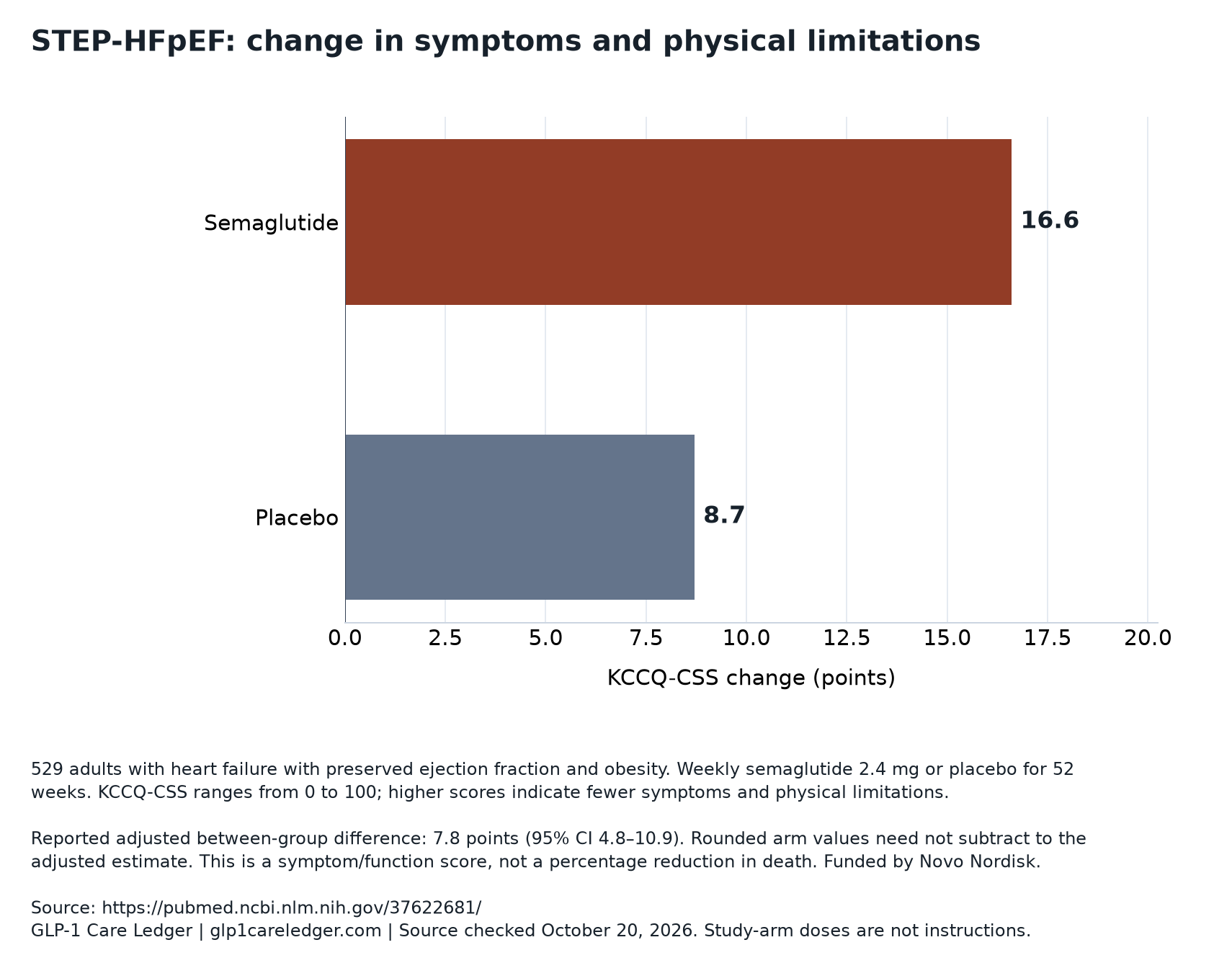
- KCCQ-CSS improved by 16.6 points with semaglutide and 8.7 with placebo; the reported estimated difference was 7.8 points, with a 95% confidence interval of 4.8 to 10.9.Sources: [1]
- Walking performance
- Six-minute walk distance improved by 21.5 meters versus 1.2 meters, an estimated between-group difference of 20.3 meters, with a 95% confidence interval of 8.6 to 32.1.Sources: [1]
- Composite interpretation
- The hierarchical composite favored semaglutide with a win ratio of 1.72. That is not a mortality hazard ratio or a 72% reduction in risk.Sources: [1]
- Reported serious adverse events
- Serious adverse events occurred in 35 semaglutide participants, or 13.3%, and 71 placebo participants, or 26.7%; these figures are not a complete side-effect profile.Sources: [1]
A trial of obesity-related heart-failure burden
Heart failure with preserved ejection fraction, abbreviated HFpEF, can involve substantial symptoms and impaired activity despite preservation of the fraction of blood pumped out with each heartbeat. STEP-HFpEF focused on people who also had obesity, defined for enrollment as a body-mass index of at least 30. Its findings therefore address a particular clinical population, rather than everyone with breathlessness, obesity, or heart failure.
Researchers randomly assigned 529 participants to semaglutide 2.4 mg once weekly or placebo for 52 weeks. Randomization strengthens the comparison by reducing systematic differences between treatment groups at the outset. The dose identifies the study arm, not a treatment instruction. The supplied STEP-HFpEF abstract states the weekly regimen but does not specify its administration route; the separate SELECT abstract explicitly describes subcutaneous semaglutide.
Novo Nordisk funded STEP-HFpEF. Its two primary endpoints were changes in a heart-failure health-status score and body weight. That choice matters: the trial was designed primarily to test symptom and weight effects over one year, not to establish a survival advantage or calculate whether medication spending would be offset by fewer medical expenses.
Reading the symptom score without inflating the result
The Kansas City Cardiomyopathy Questionnaire clinical summary score, or KCCQ-CSS, measures heart-failure symptoms and physical limitations. It runs from 0 to 100, with higher scores indicating fewer symptoms and limitations. This makes it a patient-centered endpoint: it captures aspects of how people feel and what they can do, rather than only a laboratory measurement.
The mean improvement was 16.6 points in the semaglutide group and 8.7 points in the placebo group. The trial reported an estimated between-group difference of 7.8 points, with a 95% confidence interval from 4.8 to 10.9. Simple subtraction of the displayed, rounded group changes gives 7.9; the reported estimated contrast is the appropriate result to retain rather than substituting that arithmetic difference.
Both groups improved, so attributing the entire 16.6-point change to semaglutide would overstate its incremental effect. The comparison with placebo estimates the added benefit under trial conditions. The confidence interval supports a positive average effect while allowing uncertainty about its size. It does not show how many individuals experienced a particular degree of improvement or guarantee a similar response for every patient.
STUDY DATA · GLP-1 Care Ledger
STEP-HFpEF: change in symptoms and physical limitations
529 adults with heart failure with preserved ejection fraction and obesity. Weekly semaglutide 2.4 mg or placebo for 52 weeks. KCCQ-CSS ranges from 0 to 100; higher scores indicate fewer symptoms and physical limitations.
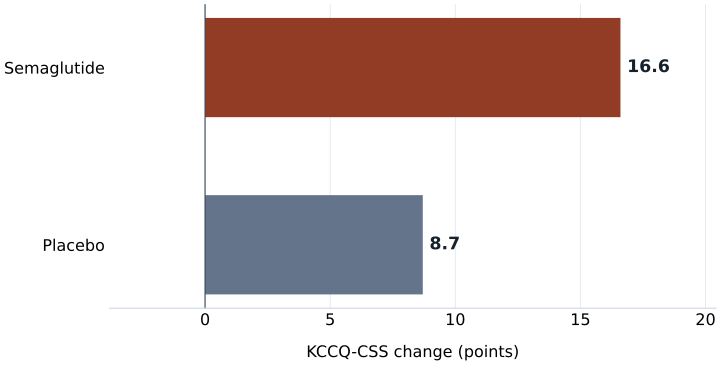
| Study group | KCCQ-CSS change (points) |
|---|---|
| Semaglutide | 16.6 |
| Placebo | 8.7 |
Reported adjusted between-group difference: 7.8 points (95% CI 4.8–10.9). Rounded arm values need not subtract to the adjusted estimate. This is a symptom/function score, not a percentage reduction in death. Funded by Novo Nordisk.
Original visualization of published aggregate data. No individual prediction or provider performance is represented. Original research ↗
Weight and walking answer different questions
Mean body weight changed by −13.3% with semaglutide and −2.6% with placebo. The estimated difference was −10.7 percentage points, with a 95% confidence interval from −11.9 to −9.4. Percentage points are the correct unit for comparing these percentage changes. Calling the result merely a 10.7% difference would blur the distinction between an absolute difference in percentages and a relative comparison.
Walking performance supplied a separate functional test. In the six-minute walk assessment, mean distance increased by 21.5 meters with semaglutide and 1.2 meters with placebo. The estimated treatment difference was 20.3 meters, with a 95% confidence interval of 8.6 to 32.1. This supports improved performance on the measured test, but it does not translate directly into a particular daily activity regained.
Together, the symptom questionnaire and walk test offer complementary evidence: one records participants’ experience, while the other measures performance during a defined task. Weight loss accompanied both improvements. However, these parallel findings do not establish how much of the symptom or walking benefit was caused by weight change, rather than by other treatment-related pathways.
| Measure | Reported result | What the comparison supports |
|---|---|---|
| KCCQ-CSS | 16.6 versus 8.7 points improved; estimated difference 7.8 points (95% CI, 4.8 to 10.9) | Greater average improvement in symptoms and physical limitations |
| Body weight | −13.3% versus −2.6%; estimated difference −10.7 percentage points (95% CI, −11.9 to −9.4) | Greater average percentage weight reduction |
| Six-minute walk distance | +21.5 versus +1.2 meters; estimated difference 20.3 meters (95% CI, 8.6 to 32.1) | Better performance on a defined walking test |
| Hierarchical composite | Win ratio 1.72 (95% CI, 1.37 to 2.15) | More favorable prioritized comparisons, not a mortality-risk estimate |
Why the win ratio is not a survival statistic
STEP-HFpEF also assessed a hierarchical composite that included death, heart-failure events, and differences in changes in KCCQ-CSS and walking distance. A hierarchical analysis orders outcomes by priority when comparing participants. Unlike an ordinary event count, it can incorporate both major clinical events and differences in symptoms or function within one summary measure.
The reported win ratio was 1.72, with a 95% confidence interval of 1.37 to 2.15. This means the analysis produced more favorable comparisons for semaglutide than for placebo under its comparison rules. It does not mean mortality fell by 72%, and it cannot be converted into a mortality hazard ratio. The indexed abstract does not provide enough detail to reconstruct which outcome levels generated the wins.
That distinction is especially important when comparing this trial with SUMMIT’s heart-failure composite. A favorable composite can support an overall treatment effect without showing that every component improved. STEP-HFpEF’s symptom and walking results are directly reported and interpretable; a separate survival claim would require mortality evidence that this abstract does not establish.
Inflammation changed, but the mechanism remains unsettled
C-reactive protein, or CRP, was another confirmatory secondary endpoint. CRP is a marker associated with inflammation, not a direct measurement of how a person feels or functions. Mean CRP changed by −43.5% with semaglutide and −7.3% with placebo. The reported estimated treatment ratio was 0.61, with a 95% confidence interval of 0.51 to 0.72.
The treatment ratio is a different statistical summary from the difference between the displayed percentage changes. It should not be rewritten as a 0.61-point reduction or confused with a cardiovascular hazard ratio. The result supports a treatment-associated difference in this biomarker, but the abstract does not establish that reducing CRP caused the symptom or exercise benefits.
Several mechanisms could contribute to better health status in obesity-related HFpEF, but this report does not separate them. A useful unresolved question is whether particular biological changes explain the benefit independently of weight reduction. Another is whether biomarker improvement predicts lasting clinical benefit. Neither question can be answered merely because weight, CRP, and symptoms all moved favorably during the same trial.
Serious events and tolerability are not interchangeable
Serious adverse events were reported in 35 participants receiving semaglutide, or 13.3%, compared with 71 receiving placebo, or 26.7%. This is a meaningful safety observation within STEP-HFpEF. It does not, however, show that every recorded event was caused or prevented by the assigned drug, and the abstract does not provide an event-by-event breakdown.
A serious-event total also answers a different question from how often treatment produces troublesome symptoms or must be discontinued. The supplied STEP-HFpEF abstract does not enumerate gastrointestinal adverse effects, dose interruptions, or discontinuation rates. Their absence from the abstract should not be mistaken for evidence that they did not occur.
Other trials illustrate why these categories need to remain separate. In SELECT, adverse events leading to permanent discontinuation occurred in 16.6% of semaglutide recipients versus 8.2% with placebo. In SUMMIT, adverse events leading to discontinuation—mainly gastrointestinal—occurred in 6.3% with tirzepatide versus 1.4% with placebo. Different populations and follow-up periods prevent using those rates as STEP-HFpEF estimates, but they demonstrate why a favorable serious-event comparison is not a blanket tolerability verdict.
What SUMMIT adds—and why it is not a head-to-head test
SUMMIT studied a different medication, tirzepatide, in 731 participants with heart failure, an ejection fraction of at least 50%, and BMI of at least 30. Participants received subcutaneous tirzepatide up to 15 mg weekly or placebo. Median follow-up was 104 weeks. Eli Lilly funded the trial, which evaluated both a cardiovascular death-or-worsening-heart-failure composite and KCCQ-CSS change.
The clinical composite occurred in 9.9% with tirzepatide and 15.3% with placebo, with a hazard ratio of 0.62 and 95% confidence interval of 0.41 to 0.95. A hazard ratio summarizes relative event rates over time, not simply the ratio of the displayed percentages. Worsening-heart-failure events favored tirzepatide, but cardiovascular deaths were 8 versus 5, with a highly uncertain hazard ratio of 1.58 (95% CI, 0.52 to 4.83).
At 52 weeks, SUMMIT’s KCCQ-CSS improvements were 19.5 versus 12.7 points, with a reported difference of 6.9 points (95% CI, 3.3 to 10.6). Comparing that number directly with STEP-HFpEF’s 7.8-point estimate cannot establish which drug is better. The participants, trial designs, and comparators’ responses differed, and neither trial randomized semaglutide against tirzepatide.
| Trial and population | Time frame | Main evidence relevant here |
|---|---|---|
| STEP-HFpEF: 529 people with HFpEF and obesity | 52 weeks | Semaglutide effects on symptoms, physical limitations, weight, and walking |
| SUMMIT: 731 people with heart failure, ejection fraction ≥50%, and obesity | Median follow-up 104 weeks; health status at 52 weeks | Tirzepatide effects on a cardiovascular death/worsening-heart-failure composite and health status |
| SELECT: 17,604 people with established cardiovascular disease, BMI ≥27, and no diabetes history | Mean follow-up 39.8 months | Semaglutide effects on cardiovascular death, nonfatal heart attack, or nonfatal stroke |
SELECT provides cardiovascular context, not an HFpEF substitute
SELECT enrolled 17,604 adults aged at least 45 with established cardiovascular disease, BMI of at least 27, and no history of diabetes. It compared weekly subcutaneous semaglutide 2.4 mg with placebo. Its primary endpoint was cardiovascular death, nonfatal myocardial infarction, or nonfatal stroke—not the STEP-HFpEF symptom-and-weight pairing.
Over a mean follow-up of 39.8 months, the primary event occurred in 569 of 8,803 semaglutide participants, or 6.5%, and 701 of 8,801 placebo participants, or 8.0%. The hazard ratio was 0.80, with a 95% confidence interval of 0.72 to 0.90. The displayed proportions differ by 1.5 percentage points; that absolute difference and the hazard ratio describe different aspects of the result.
The SELECT cardiovascular-outcomes analysis helps distinguish event prevention from symptom improvement. SELECT, also funded by Novo Nordisk, strengthens evidence for semaglutide in its enrolled cardiovascular population. It does not retroactively make STEP-HFpEF a mortality trial, establish that each SELECT component improved separately, or show that one year of HFpEF symptom improvement will produce a particular financial return.
A 52-week result is not a lifetime cost forecast
STEP-HFpEF measured outcomes during 52 weeks of assigned treatment. The supplied report does not establish how long benefits persist after treatment ends, what happens under irregular access, or what ongoing care will cost. It also does not report a cost-effectiveness analysis. Better symptoms may be valuable without producing documented savings large enough to cover treatment spending.
Editorial interpretation: a defensible budget should separate the price of obtaining care from the value someone places on the measured benefits. The budget workbook can organize a written quote, while the billing-cycle guide helps distinguish calendar-month charges from four-week billing. Neither exercise supplies a clinical prediction; it makes the financial assumptions visible.
Editorial interpretation: follow-up expenses and renewal terms belong beside the medication charge, not outside the comparison. The follow-up care cost guide offers a way to structure those questions. For a provider-specific document check, the Ro review can be used to examine membership and payment terms; that link does not imply availability of the studied product, HFpEF-specific care, or trial-like outcomes.
Product identity is part of the evidence boundary
Clinical findings do not automatically transfer to another formulation, an oral route, a compounded preparation, or a commercial provider. The treatment comparison tested in a randomized trial is more specific than a broad medication category. A lower-priced offering therefore cannot inherit STEP-HFpEF’s symptom or walking results simply because its description uses the name semaglutide.
The supplied FDA material states that compounded drugs are not FDA approved or reviewed before marketing for safety, effectiveness, or quality. It identifies concerns involving dosing errors and semaglutide salt ingredients, and recommends compounded products only when a patient’s needs cannot be met by an FDA-approved drug. Adverse-event reports alone cannot establish rates or causation.
Editorial interpretation: comparing prices responsibly requires identifying the actual product and documentary terms before comparing totals. The compounded-pricing guide addresses that distinction. A quote may clarify payment obligations, but it cannot establish therapeutic equivalence. Likewise, neither the trial’s historical background language nor its positive results should be treated as current prescribing information or proof of a present regulatory indication.
Questions & answers
Does the 7.8-point KCCQ-CSS difference mean symptoms improved by 7.8%?
No. It is a difference in points on a 0–100 questionnaire scale, not a percentage reduction in symptoms. The average changes were 16.6 points with semaglutide and 8.7 with placebo, with a reported estimated difference of 7.8. The result describes an average treatment contrast; it does not identify every participant’s response.
Did STEP-HFpEF prove that semaglutide prevents death from heart failure?
The supplied report does not establish that conclusion. Death was included in a hierarchical composite alongside heart-failure events, symptoms, and walking changes. Its win ratio is not a mortality estimate. The clearest directly reported findings concern symptoms, physical limitations, weight, and walking performance over 52 weeks.
Why did the placebo group improve too?
The abstract reports improvement but does not determine why it occurred. Changes during participation can have multiple explanations, and these data do not separate them. That is precisely why the randomized between-group comparison matters: the added treatment effect should not be equated with the entire improvement observed in the semaglutide group.
Can SUMMIT tell me whether tirzepatide works better than semaglutide for HFpEF?
Not from these reports. SUMMIT compared tirzepatide with placebo, while STEP-HFpEF compared semaglutide with placebo. Differences in populations, follow-up, endpoint structures, and placebo responses prevent a reliable ranking from their numerical results. SUMMIT adds important heart-failure event evidence, but it is not a direct comparison of the two drugs.
Did the trial show that treatment pays for itself?
No economic result of that kind appears in the supplied STEP-HFpEF abstract. Symptom improvement, fewer medical expenses, and net financial savings are separate outcomes. Editorially, a budget should use documented charges and renewal terms rather than assume that clinical benefits will offset costs. The trial also does not establish the financial consequences of interrupted access.
Our assessment
STEP-HFpEF provides randomized evidence that weekly semaglutide improved average symptoms, physical limitations, weight, and six-minute walking performance more than placebo over 52 weeks in people with HFpEF and obesity. Its strongest contribution is demonstrating benefits beyond the scale, not establishing a mortality reduction. SUMMIT and SELECT address related but distinct event questions and should remain separate in interpretation. For budgeting, the evidence supports recognizing a measured clinical benefit while leaving price, continuity, economic value, and post-treatment durability as unresolved questions—not assumed advantages.
Sources & documentation
Scientific and official sources consulted October 20, 2026. Study findings apply to the populations, products and time periods described; they are not provider outcome data.