A direct comparison answers a question that separate placebo-controlled studies cannot settle as cleanly: what happens when similar participants are randomly assigned to two different treatments within the same trial? SURMOUNT-5 compared weekly injectable tirzepatide with weekly injectable semaglutide in 751 adults with obesity but without type 2 diabetes. At 72 weeks, the estimated average weight reduction was greater with tirzepatide. Understanding exactly what was compared is essential before turning that result into expectations about health, treatment duration, or spending.
For readers weighing the financial commitment of obesity treatment, the key distinction is between evidence of benefit and evidence of value at a particular price. SURMOUNT-5 provides the former, not an economic evaluation. This analysis uses the indexed primary report abstracts and the available official FDA material; it does not represent a review of complete trial protocols, supplements, or full texts. The findings below are therefore kept within what those cited sources establish.
At a glance
- Direct randomized comparison
- SURMOUNT-5 assigned 751 adults with obesity but without type 2 diabetes to tirzepatide or semaglutide in a 1:1 ratio; treatment was open-label.Sources: [1]
- Regimens studied
- Participants received maximum tolerated once-weekly subcutaneous tirzepatide, 10 or 15 mg, or semaglutide, 1.7 or 2.4 mg, for 72 weeks. These doses identify trial arms, not treatment instructions.Sources: [1]
- Average weight outcome
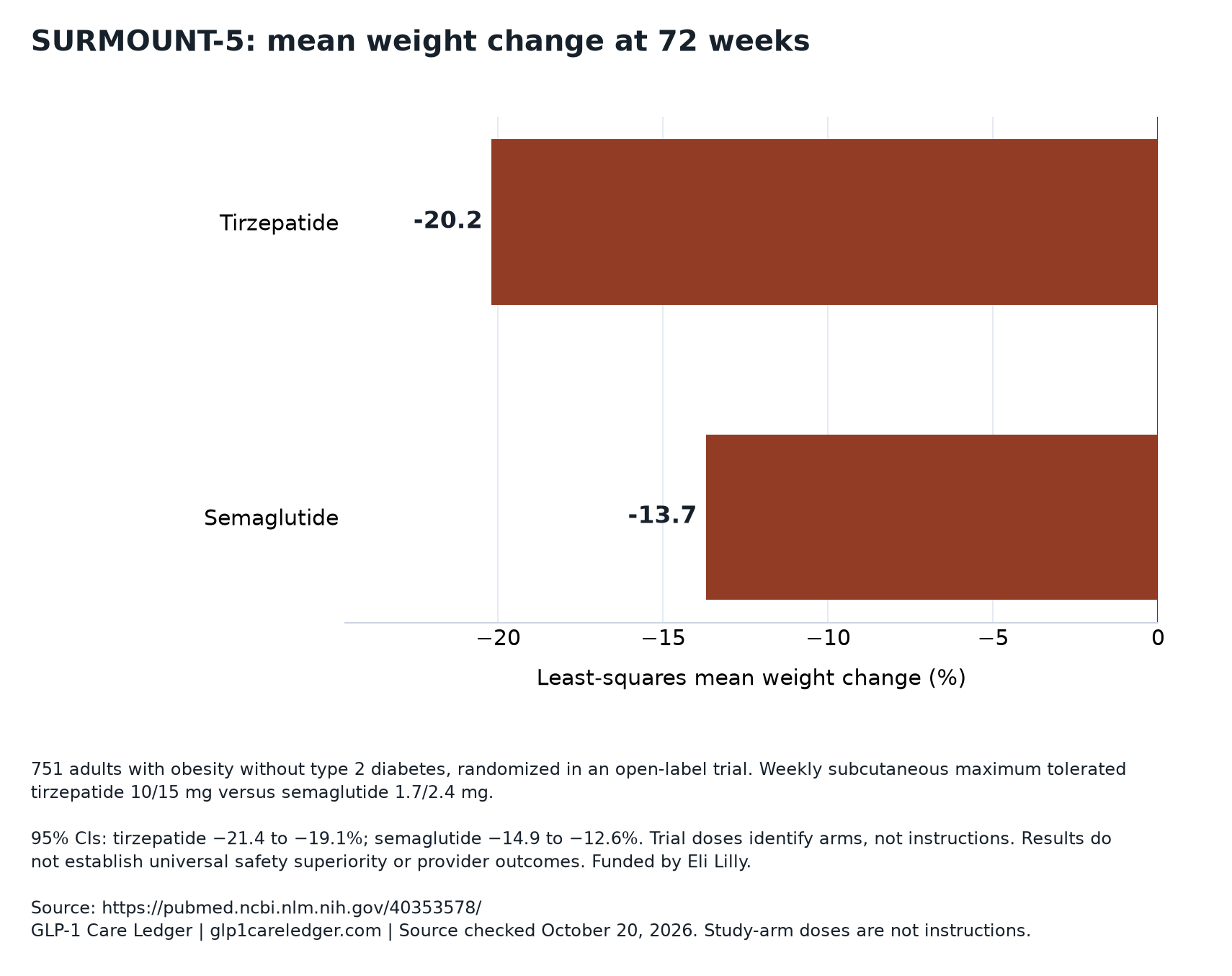
- Least-squares mean weight change was −20.2% with tirzepatide and −13.7% with semaglutide, a 6.5-percentage-point separation between the reported estimates.Sources: [1]
- Tolerability findings
- The most common adverse events in both groups were gastrointestinal, generally mild to moderate, and concentrated primarily during dose escalation.Sources: [1]
A stronger comparison starts with random assignment
SURMOUNT-5 was a phase 3b, randomized, controlled trial funded by Eli Lilly. Its population consisted of adults with obesity who did not have type 2 diabetes. The comparator was another active medication rather than placebo, making the study particularly useful for estimating the relative weight effects of these two treatment strategies.
Random assignment reduces the chance that baseline differences between treatment groups explain their outcomes. Unlike comparing the headline results of two unrelated trials, this design places both medications within one study framework and one follow-up period. It supports a causal comparison of assignment to the studied regimens more directly than a comparison assembled across separate research programs.
The population boundary still matters. These findings are not direct estimates for people with type 2 diabetes, children, or everyone who might seek weight management. The indexed abstract also does not provide a detailed demographic breakdown or subgroup results. It therefore cannot establish whether the average advantage was the same across ages, starting weights, or other participant characteristics.
| Design feature | Reported trial detail | Why it matters |
|---|---|---|
| Population | 751 adults with obesity, without type 2 diabetes | Defines the population directly studied |
| Assignment | Randomized 1:1; open-label | Strengthens comparability, but treatment identity was known |
| Tirzepatide strategy | Maximum tolerated 10 or 15 mg, injected weekly | Not a comparison limited to one fixed dose |
| Semaglutide strategy | Maximum tolerated 1.7 or 2.4 mg, injected weekly | Includes two tolerated dose levels |
| Duration and primary endpoint | 72 weeks; percent weight change from baseline | Measures weight over a defined period, not lifetime outcomes |
Maximum tolerated dosing defines the question
Both medications were administered subcutaneously, meaning injected under the skin, once weekly. Participants were assigned to a maximum tolerated dose strategy: tirzepatide at 10 or 15 mg, or semaglutide at 1.7 or 2.4 mg. Those are descriptions of the research arms, not a schedule for starting, escalating, or changing treatment.
This was therefore not simply a fixed-dose comparison of tirzepatide 15 mg against semaglutide 2.4 mg in every participant. Tolerability could determine which of the specified doses a participant received. The result applies to the treatment strategies as studied; the abstract does not isolate the comparative effect of every individual dose pairing.
The indexed abstract does not report how many participants reached each dose, their cumulative exposure at each level, or detailed escalation rules. Those missing details limit attempts to explain the overall difference through dose exposure alone. They also prevent translating the result into a prediction about someone who receives a different dose or remains at an earlier treatment stage.
STUDY DATA · GLP-1 Care Ledger
SURMOUNT-5: mean weight change at 72 weeks
751 adults with obesity without type 2 diabetes, randomized in an open-label trial. Weekly subcutaneous maximum tolerated tirzepatide 10/15 mg versus semaglutide 1.7/2.4 mg.
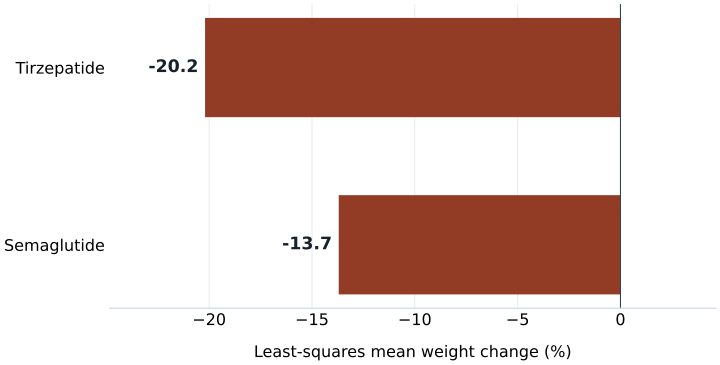
| Study group | Least-squares mean weight change (%) |
|---|---|
| Tirzepatide | -20.2 |
| Semaglutide | -13.7 |
95% CIs: tirzepatide −21.4 to −19.1%; semaglutide −14.9 to −12.6%. Trial doses identify arms, not instructions. Results do not establish universal safety superiority or provider outcomes. Funded by Eli Lilly.
Original visualization of published aggregate data. No individual prediction or provider performance is represented. Original research ↗
Reading the 6.5-percentage-point difference correctly
The primary endpoint was percentage change in body weight from baseline to week 72. The least-squares mean change was −20.2% with tirzepatide, with a 95% confidence interval from −21.4% to −19.1%. For semaglutide, it was −13.7%, with a 95% confidence interval from −14.9% to −12.6%. Negative values indicate weight reduction.
Subtracting the reported estimates gives a 6.5-percentage-point greater reduction with tirzepatide. This is not a 6.5% reduction in the probability of an event. As an arithmetic illustration—not a participant prediction—a person starting at 100 kilograms would have a 20.2-kilogram reduction at 20.2%, versus 13.7 kilograms at 13.7%. Starting weight changes the corresponding kilogram amounts.
The report gives a P value below 0.001 for the weight comparison, supporting a difference beyond what the statistical model would ordinarily attribute to chance under a no-difference assumption. Statistical significance does not specify how important that difference is to an individual, what it costs to achieve, or whether it persists after treatment ends.
An adjusted average is not an individual forecast
A least-squares mean is a model-based estimate of a group average rather than simply the raw arithmetic average of all recorded measurements. Such estimates depend on the analysis model and its handling of the available data. The indexed abstract identifies the estimate but does not provide enough detail to reconstruct its adjustment variables or missing-data assumptions.
The confidence intervals describe uncertainty around the estimated group means under the analysis assumptions. They are not ranges containing 95% of individual participants’ weight changes. Someone can have a result well outside those intervals without contradicting the study, because variation between people is different from uncertainty about an average.
The abstract reports intervals for each treatment mean but not a confidence interval for their difference. The 6.5-percentage-point subtraction is useful descriptive arithmetic; it is not a separately reported interval estimate. A valid interval for the between-group contrast cannot be recovered merely by subtracting the endpoints of the two published intervals.
Waist and threshold results add context, not guarantees
Waist circumference was a key secondary endpoint. Its least-squares mean change was −18.4 centimeters with tirzepatide, with a 95% confidence interval from −19.6 to −17.2 centimeters. With semaglutide, it was −13.0 centimeters, with a 95% confidence interval from −14.3 to −11.7 centimeters. The reported comparison had a P value below 0.001.
The 5.4-centimeter separation between those estimates supports a difference beyond the scale alone. However, waist circumference is a body-size measurement, not a direct measurement of cardiovascular events, physical function, or body composition. The abstract does not establish which tissue compartments accounted for the weight difference or how much functional benefit accompanied it.
Participants assigned to tirzepatide were also more likely to reach weight-loss thresholds of at least 10%, 15%, 20%, and 25%. Threshold outcomes help distinguish the proportion reaching a specified milestone from the average change. Because the indexed abstract does not give those proportions, it cannot support exact milestone probabilities or absolute differences in responder rates.
Open-label treatment and real adverse effects
Open-label means that treatment assignment was known rather than concealed from participants and investigators. Randomization remains valuable, but knowing the treatment can influence expectations, symptom reporting, persistence, or behavior. Weight is a measured outcome, yet that does not make every pathway leading to the measurement immune to knowledge of treatment assignment.
The most common adverse events in both SURMOUNT-5 groups were gastrointestinal. Most were mild to moderate and occurred primarily during dose escalation. That pattern is clinically relevant: tolerability problems can arise during the process of reaching a treatment dose, rather than being evenly distributed across the entire 72 weeks.
The indexed abstract does not give comparative event counts, serious-event rates, or discontinuation percentages. It therefore does not support a universal safety winner. Greater average weight reduction is an efficacy finding, not proof that one treatment causes fewer harms. Likewise, the description of most events as mild to moderate does not mean all events were mild or that treatment was tolerable for everyone.
Earlier placebo trials answer different questions
STEP 1 studied 1,961 adults without diabetes for 68 weeks, comparing weekly injected semaglutide 2.4 mg with placebo, alongside lifestyle intervention. Mean weight change was −14.9% versus −2.4%; the reported estimated difference was −12.4 percentage points, with a 95% confidence interval from −13.4 to −11.5. Its primary estimand assessed effects regardless of discontinuation or rescue interventions.
SURMOUNT-1 assigned 2,539 adults without diabetes to tirzepatide 5, 10, or 15 mg or placebo for 72 weeks, including a 20-week escalation period. Mean changes were −15.0%, −19.5%, and −20.9%, respectively, versus −3.1% with placebo. Its treatment-regimen estimand likewise addressed effects regardless of discontinuation. These studies established placebo comparisons, not randomized comparisons between the two drugs.
Safety figures also belong to their own study contexts. In STEP 1, gastrointestinal events led to discontinuation in 4.5% with semaglutide versus 0.8% with placebo. In SURMOUNT-1, adverse events caused discontinuation in 4.3%, 7.1%, and 6.2% across increasing tirzepatide doses, versus 2.6% with placebo. Different populations, follow-up, and event definitions prevent treating these figures as a head-to-head safety ranking.
| Trial | Comparison and timeframe | Primary question |
|---|---|---|
| SURMOUNT-5 | Tirzepatide versus semaglutide; 72 weeks | Which studied strategy produced greater percentage weight reduction? |
| STEP 1 | Semaglutide versus placebo; 68 weeks | What weight benefit occurred beyond placebo plus lifestyle intervention? |
| SURMOUNT-1 | Three tirzepatide doses versus placebo; 72 weeks | What weight effects occurred across the studied doses? |
| SELECT | Semaglutide versus placebo; mean follow-up 39.8 months | Was a first major cardiovascular composite event less frequent? |
Greater weight loss is not a cardiovascular verdict
SELECT illustrates why the endpoint matters. It enrolled 17,604 people aged at least 45 years with established cardiovascular disease, BMI of at least 27, and no history of diabetes. The double-blind trial compared weekly injected semaglutide 2.4 mg with placebo. Its primary endpoint combined cardiovascular death, nonfatal heart attack, and nonfatal stroke in a time-to-first-event analysis.
Over a mean 39.8 months of follow-up, that composite occurred in 6.5% of the semaglutide group and 8.0% of the placebo group. The hazard ratio was 0.80, with a 95% confidence interval of 0.72 to 0.90. This describes a lower estimated event hazard over follow-up, not a 20-percentage-point absolute reduction. The observed proportions differed by 1.5 percentage points.
The composite result does not establish that every component improved separately, and SELECT did not compare semaglutide with tirzepatide. Adverse events leading to permanent discontinuation occurred in 16.6% versus 8.2%. Our SELECT analysis explores that distinct evidence question. Similarly, randomized withdrawal research concerns maintenance; SURMOUNT-5’s week-72 result does not itself answer what happens after withdrawal.
The formulation boundary cannot be priced away
SURMOUNT-5 tested specified injectable regimens. Its efficacy estimates do not automatically transfer to oral formulations, different dosing strategies, or compounded preparations. Sharing an ingredient name does not demonstrate equivalent formulation quality, exposure, delivery, or clinical outcomes. A lower advertised price cannot fill that evidentiary gap.
FDA states that compounded drugs are not FDA approved and are not reviewed before marketing for safety, effectiveness, or quality. Its cited material identifies dosing errors and concerns about semaglutide salt ingredients. It recommends compounded products only when a patient’s needs cannot be met by an FDA-approved drug, with a prescription and a state-licensed pharmacy.
Reports of problems do not by themselves establish event rates or causation, so they should not be converted into an invented comparative risk percentage. The defensible conclusion is narrower: this trial does not validate a compounded substitute. The compounded-pricing guide separates a price comparison from the additional evidence needed to claim product equivalence.
Budgeting interpretation: match the contract to the evidence horizon
Editorial interpretation: a 72-week efficacy result should prompt questions about the financial horizon, not an assumption that 72 weeks is a complete or recommended course. SURMOUNT-5 does not report prices, insurance payments, cost-effectiveness, or the expense of continued treatment. Dividing an advertised monthly fee by the average weight-loss percentage would mix a commercial quote with a research outcome that the purchaser is not guaranteed to achieve.
A useful financial comparison instead begins with documented terms: payment frequency, renewal prices, included services, and separate charges. The billing-cycle guide and budget workbook help organize those inputs. This is budgeting reasoning, not a trial-derived claim that one medication or program delivers better economic value.
Provider rankings cannot be extracted from randomization between medications. For documentary checks only, the Ro review and Mochi Health review offer places to examine payment terms; these links do not imply access to either studied product or trial-like outcomes. A program’s commercial structure and its ability to reproduce a clinical result are separate questions.
Questions & answers
Does SURMOUNT-5 show that tirzepatide is better for everyone?
No. It showed greater average reductions in weight and waist circumference with the studied tirzepatide strategy in adults with obesity without type 2 diabetes. An average treatment advantage does not determine every participant’s response, tolerability, or priorities. The indexed abstract does not provide individual prediction rules or establish superiority for every health outcome.
Why is semaglutide’s result different from the STEP 1 headline?
STEP 1 and SURMOUNT-5 used different designs, comparators, durations, and treatment strategies. STEP 1 compared semaglutide 2.4 mg with placebo over 68 weeks; SURMOUNT-5 used maximum tolerated semaglutide 1.7 or 2.4 mg against tirzepatide over 72 weeks. Their averages need not match. The difference between their semaglutide estimates is not itself a randomized finding.
Can the weight-loss difference be used to calculate value per dollar?
Not from this evidence alone. SURMOUNT-5 supplies group-level clinical outcomes but no economic analysis. A meaningful value assessment would require clearly defined costs, duration, outcomes, and assumptions about continuation and discontinuation. Editorially, written quotes can support a spending comparison, but they cannot turn a group average into a guaranteed personal return.
Does 72 weeks tell us when treatment should end?
No. It identifies the trial’s treatment period and primary assessment point. It does not establish an optimal stopping time, a tapering strategy, or the durability of weight reduction after stopping. Those are different scientific questions requiring evidence specifically designed to examine continuation, withdrawal, or longer-term follow-up.
Can a compounded product use these same expected results?
The trial does not establish that equivalence. FDA notes that compounded preparations are not reviewed before marketing for safety, effectiveness, or quality. The SURMOUNT-5 estimates belong to its studied injectable regimens, not automatically to products sold under similar ingredient descriptions. Neither a provider’s pricing nor an ingredient label demonstrates the same clinical performance.
Our assessment
SURMOUNT-5 provides strong direct evidence that the studied maximum tolerated injectable tirzepatide strategy produced greater average weight and waist reductions than the studied semaglutide strategy over 72 weeks. Its randomized design is more informative for that comparison than juxtaposing separate placebo trials. The remaining boundaries are substantial but specific: incomplete safety detail in the indexed abstract, no individual response forecast, no comparative cardiovascular endpoint, and no economic evaluation. For budgeting, the appropriate interpretation is to keep measured clinical benefit, documented commercial terms, and uncertain future treatment needs separate rather than compressing them into a single claim of best value.
Sources & documentation
Scientific and official sources consulted October 20, 2026. Study findings apply to the populations, products and time periods described; they are not provider outcome data.
- Tirzepatide as Compared with Semaglutide for the Treatment of Obesity. ↗
- Once-Weekly Semaglutide in Adults with Overweight or Obesity. ↗
- Tirzepatide Once Weekly for the Treatment of Obesity. ↗
- Semaglutide and Cardiovascular Outcomes in Obesity without Diabetes. ↗
- FDA concerns about unapproved GLP-1 drugs ↗