A sleep-apnea treatment can produce a large numerical improvement without eliminating the condition. That distinction is central to SURMOUNT-OSA, two trials testing tirzepatide in adults with obesity and moderate-to-severe obstructive sleep apnea. After 52 weeks, participants assigned to tirzepatide had larger reductions in breathing interruptions than those assigned to placebo. The findings concern objectively measured sleep disease, not simply weight change or reports of better rest.
For readers evaluating treatment value, the first task is to understand what the trials actually purchased in scientific terms: a year of observation, a specific injected medicine, and defined sleep-related outcomes. They did not establish lifetime affordability, savings on sleep-apnea care, or an individual timetable for ending other treatment. This analysis uses the indexed primary report abstracts and the supplied official FDA and NIDDK material; it does not claim examination of full protocols, supplements, or complete trial reports.
At a glance
- Study population
- Two trials enrolled 469 adults with obesity and moderate-to-severe obstructive sleep apnea, without type 2 diabetes, according to the FDA.Sources: [2]
- Two PAP settings
- Trial 1 enrolled people not receiving positive airway pressure at baseline; trial 2 enrolled people receiving PAP.Sources: [1]
- Treatment and duration
- Participants were assigned to weekly tirzepatide injections at a maximum tolerated dose of 10 or 15 mg, or placebo, for 52 weeks. These doses identify study arms, not personal dosing instructions.
- Primary result
- The placebo-adjusted reduction in apnea-hypopnea index was 20.0 events per hour in trial 1 and 23.8 events per hour in trial 2.Sources: [1]
- Safety finding
- The most frequently reported adverse events with tirzepatide were gastrointestinal and mostly mild to moderate; the indexed abstract does not provide their frequencies.Sources: [1]
Two trials answered related, but different, questions
SURMOUNT-OSA used two phase 3, randomized, double-blind, placebo-controlled trials. Random assignment helps separate treatment effects from differences in the people choosing treatment. Double blinding means treatment assignments were concealed from participants and study personnel under the study design. Each trial assigned participants in a 1:1 ratio to tirzepatide or placebo. Eli Lilly funded the research, registered as NCT05412004.
The important dividing line was baseline use of positive airway pressure, or PAP. Trial 1 included people not receiving PAP; the FDA describes that population as unable or unwilling to use it. Trial 2 included people receiving PAP. These were not randomized comparisons of PAP against tirzepatide, and they do not establish which approach is superior. The available abstract also does not detail how PAP use was handled around sleep testing.
The FDA reports 469 participants across the two trials, all without type 2 diabetes. That matters for applicability: these results directly describe the enrolled population, not everyone with snoring, mild apnea, diabetes, or obesity alone. Keeping the two trial populations separate is more informative than treating the combined enrollment as one uniform experiment.
| Feature | Trial 1 | Trial 2 |
|---|---|---|
| PAP status at baseline | Not receiving PAP | Receiving PAP |
| Mean baseline AHI | 51.5 events per hour | 49.5 events per hour |
| Mean baseline BMI | 39.1 | 38.7 |
| Randomized comparison | Tirzepatide versus placebo | Tirzepatide versus placebo |
| Treatment period | 52 weeks | 52 weeks |
The endpoint counts breathing interruptions per hour
The primary endpoint was change from baseline in the apnea-hypopnea index, abbreviated AHI. It counts apneas and hypopneas—episodes of stopped or reduced breathing—during each hour of sleep. An AHI reduction of 20 therefore means 20 fewer events per hour, not 20 fewer events during an entire night and not a 20% reduction. Confusing these units substantially changes the apparent result.
At enrollment, mean AHI was 51.5 events per hour in trial 1 and 49.5 in trial 2. These averages show that participants began with a high frequency of disrupted breathing. Mean body-mass index, a weight-to-height measure, was 39.1 and 38.7, respectively. The study therefore tested treatment in populations with substantial obesity and substantial sleep-disordered breathing, rather than a broadly screened population with occasional symptoms.
An hourly index makes sleep studies of different durations more comparable, but it does not describe every dimension of illness. Two people with similar AHI can differ in oxygen exposure or perceived sleep impairment. That is why the additional oxygen-related and patient-reported measurements are important: they ask whether a lower event count was accompanied by improvements beyond the count itself.
STUDY DATA · GLP-1 Care Ledger
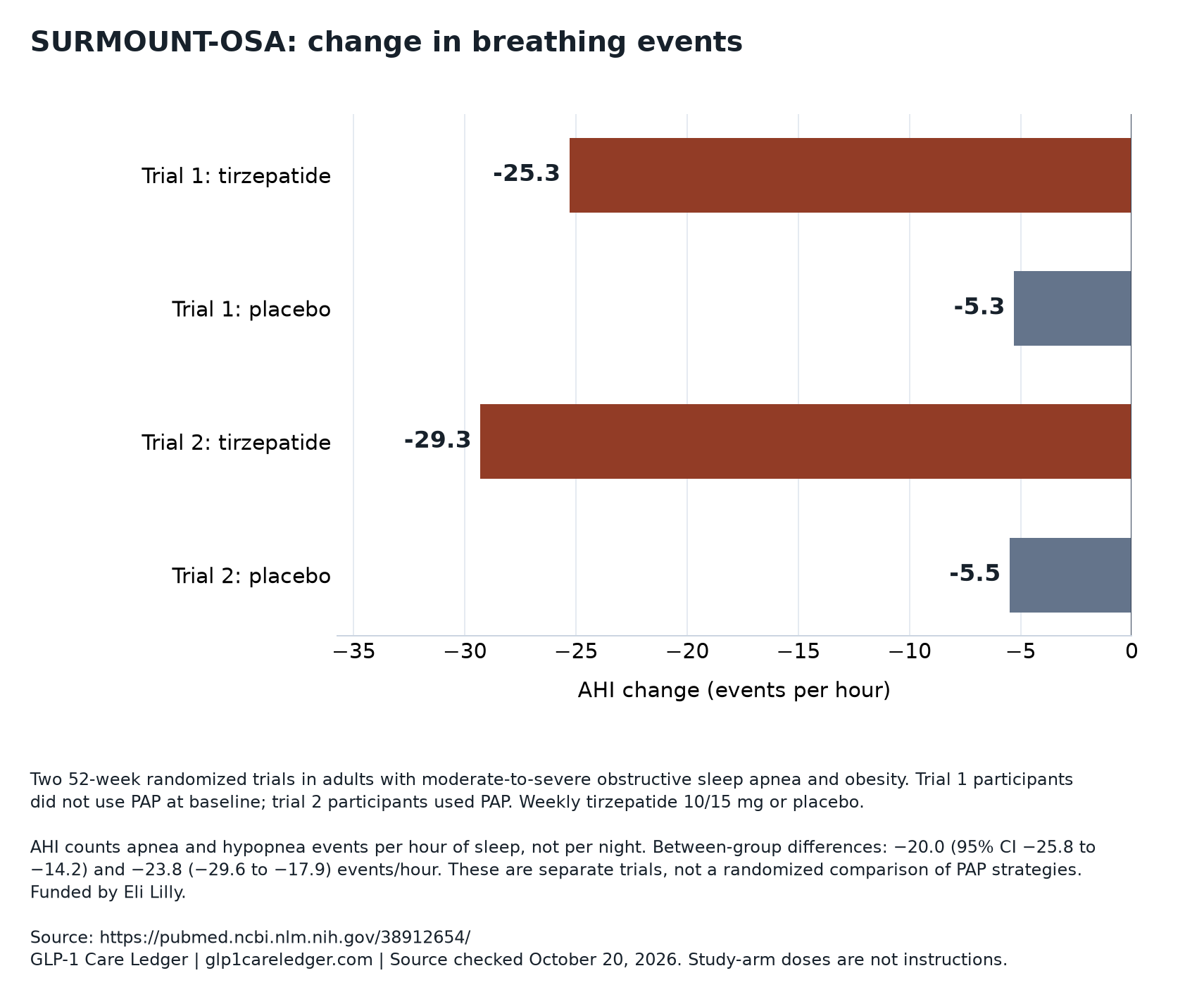
SURMOUNT-OSA: change in breathing events
Two 52-week randomized trials in adults with moderate-to-severe obstructive sleep apnea and obesity. Trial 1 participants did not use PAP at baseline; trial 2 participants used PAP. Weekly tirzepatide 10/15 mg or placebo.
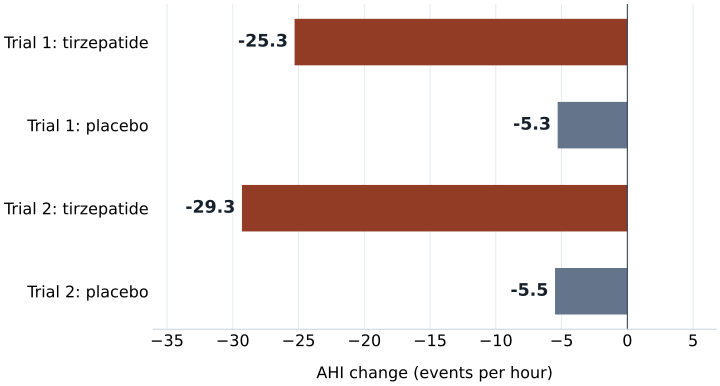
| Study group | AHI change (events per hour) |
|---|---|
| Trial 1: tirzepatide | -25.3 |
| Trial 1: placebo | -5.3 |
| Trial 2: tirzepatide | -29.3 |
| Trial 2: placebo | -5.5 |
AHI counts apnea and hypopnea events per hour of sleep, not per night. Between-group differences: −20.0 (95% CI −25.8 to −14.2) and −23.8 (−29.6 to −17.9) events/hour. These are separate trials, not a randomized comparison of PAP strategies. Funded by Eli Lilly.
Original visualization of published aggregate data. No individual prediction or provider performance is represented. Original research ↗
The placebo comparison is smaller than the drug-group change
In trial 1, mean AHI fell by 25.3 events per hour with tirzepatide, with a 95% confidence interval from a 29.3-event decrease to a 21.2-event decrease. Placebo participants also improved: their mean reduction was 5.3 events per hour, with a confidence interval from 9.4 to 1.1 fewer events. The estimated treatment difference was therefore a 20.0-event-per-hour reduction, not 25.3.
Trial 2 showed the same pattern. The tirzepatide group improved by 29.3 events per hour, while the placebo group improved by 5.5. Subtracting the placebo change gives the reported treatment difference of 23.8 fewer events per hour. Both within-group improvement and the between-group contrast are useful, but they answer different questions. The randomized contrast is the stronger estimate of the added effect of assignment to tirzepatide.
The supplied evidence does not explain how much of the placebo improvement reflected shared study conditions, natural variation, or other influences. It would be speculative to assign proportions to those explanations. What the comparator does accomplish is to avoid attributing every observed improvement in the active-treatment group to the medicine.
| AHI result | Trial 1 | Trial 2 |
|---|---|---|
| Tirzepatide mean change | −25.3; 95% CI −29.3 to −21.2 | −29.3; 95% CI −33.2 to −25.4 |
| Placebo mean change | −5.3; 95% CI −9.4 to −1.1 | −5.5; 95% CI −9.9 to −1.2 |
| Estimated treatment difference | −20.0; 95% CI −25.8 to −14.2 | −23.8; 95% CI −29.6 to −17.9 |
Confidence intervals support benefit, not a ranking of PAP groups
For trial 1, the treatment-difference confidence interval extended from 25.8 to 14.2 fewer events per hour. For trial 2, it extended from 29.6 to 17.9 fewer events. Neither interval crossed zero, supporting a reduction relative to placebo in both populations. A confidence interval describes uncertainty around the estimated average treatment effect; it is not a range within which every participant's response must fall.
Trial 2's numerical treatment difference was larger, but that does not prove that baseline PAP users respond better to tirzepatide. Participants were not randomly assigned between the two trials. Their characteristics and treatment circumstances could differ, and the indexed abstract does not report a formal comparison of the two treatment effects. The defensible conclusion is that both settings showed benefit.
The same discipline applies across studies. A direct comparison requires an appropriate design, not simply two promising numbers placed side by side. Our discussion of SURMOUNT-5 and the limits of head-to-head comparisons provides a separate framework for reading comparative evidence; it should not be mistaken for a direct comparison within SURMOUNT-OSA.
Large average reductions can leave important disease behind
An illustrative calculation shows why improvement and resolution are different. Subtracting trial 1's tirzepatide-group change of 25.3 from the overall trial baseline mean of 51.5 gives approximately 26.2 events per hour. The analogous calculation for trial 2 gives 20.2. These are editorial arithmetic illustrations, not reported treatment-group endpoint means: the baseline figures describe whole trials, and the abstract does not establish that they can be combined into exact endpoint estimates.
Even with that limitation, the arithmetic exposes an important interpretive error. Cutting a high event frequency substantially does not necessarily reduce it to a low level. The indexed abstract does not provide individual resolution rates or enough information to determine how many people had little remaining disease. A population mean also conceals variation: some participants may improve more than others.
For that reason, the results cannot determine an individual's remaining apnea severity or justify stopping PAP. Symptoms and weight change do not themselves supply a new AHI measurement. Clinical reassessment, including diagnostic follow-up as appropriate, remains a separate question from whether the trial's average endpoint improved. The FDA context specifically does not make improvement permission to discontinue PAP without the treating clinician.
Oxygen burden and reported sleep outcomes broaden the result
The trial program also assessed prespecified key secondary endpoints: percentage changes in AHI and body weight, hypoxic burden, patient-reported sleep impairment and disturbance, high-sensitivity C-reactive protein, and systolic blood pressure. Hypoxic burden concerns low-oxygen exposure, while high-sensitivity C-reactive protein is an inflammation marker. These measurements address different aspects of physiology and daily experience rather than duplicating AHI exactly.
The abstract reports significant improvements with tirzepatide versus placebo across all these key secondary endpoints, with statistical control for multiple testing. That control matters because testing many outcomes without adjustment increases the chance of apparently positive findings arising by chance. However, the indexed abstract does not provide numerical effects or confidence intervals for these secondary outcomes, so their size cannot be responsibly reconstructed.
The findings therefore support a broader pattern of improvement, but not a numerical claim about how much better participants slept or how much oxygen exposure changed. Nor do parallel changes prove a causal chain. Weight, breathing, inflammation, and blood pressure improved in the same program; the abstract does not isolate how much each change caused another.
Tolerability is part of the result, not a footnote
Participants received weekly injections of tirzepatide at a maximum tolerated dose of 10 or 15 mg, or placebo, over 52 weeks. The phrase maximum tolerated indicates that the study intervention was not simply a single identical dose for everyone. The indexed abstract does not give a titration schedule, dose-specific efficacy estimates, or the proportions ultimately receiving each dose. These arm descriptions should not be turned into instructions.
The most frequently reported adverse events with tirzepatide were gastrointestinal and mostly mild to moderate. That is a real safety finding, but it is not equivalent to saying the treatment was harmless. The indexed abstract lacks event frequencies, a detailed breakdown of specific symptoms, and discontinuation figures for SURMOUNT-OSA. Without those data, the likelihood that side effects disrupted treatment cannot be quantified here.
Benefit and tolerability also operate on different scales: a large average AHI reduction does not predict whether one person will tolerate treatment. NIDDK frames medication decisions around health history, other medicines, benefits, adverse effects, and cost. The 52-week sleep trials inform that discussion but do not settle an individual's balance of those factors.
Better sleep measures are not proof of fewer heart events
SURMOUNT-OSA measured sleep-apnea severity and related outcomes; its primary endpoint was not cardiovascular death or hospitalization. Improvements in blood pressure or inflammation cannot be converted into a percentage reduction in heart attacks or heart failure. SUMMIT, a separate Eli Lilly-funded trial, illustrates the difference between measuring physiological markers and measuring clinical events in a defined cardiovascular population.
SUMMIT enrolled 731 people with obesity and heart failure with preserved ejection fraction, meaning an ejection fraction of at least 50%. Median follow-up was 104 weeks. Cardiovascular death or worsening heart failure occurred in 9.9% with tirzepatide versus 15.3% with placebo, a 5.4-percentage-point difference. The time-to-first-event hazard ratio was 0.62, with a 95% confidence interval of 0.41 to 0.95; a hazard ratio is not the same quantity as a simple risk ratio.
The composite did not show every component improving. Cardiovascular deaths numbered eight versus five, with a highly uncertain hazard ratio of 1.58 and confidence interval of 0.52 to 4.83. Adverse events leading to drug discontinuation occurred in 6.3% versus 1.4%, mainly gastrointestinal. The SUMMIT heart-failure analysis concerns that distinct population, not an extra outcome established by the sleep-apnea trials.
Approval applies to a defined product and indication
On December 20, 2024, the FDA announced approval of Zepbound, the tirzepatide product, for moderate-to-severe obstructive sleep apnea in adults with obesity, alongside reduced-calorie diet and increased physical activity. That announcement establishes the historical approval context. It is not a substitute for current complete prescribing information, and the trial report should not be read as a current label.
The evidence is also formulation-specific. Results from the studied injected medicine do not automatically establish outcomes for oral routes, other formulations, or compounded preparations. FDA states that compounded drugs are not approved or reviewed before marketing for safety, effectiveness, or quality, and recommends them only when a patient's needs cannot be met by an approved drug. A lower quoted price cannot establish clinical equivalence.
FDA has identified dosing errors and problems involving semaglutide salt ingredients in its broader discussion of unapproved GLP-1 products. Those concerns should not be misrepresented as measured SURMOUNT-OSA event rates or as tirzepatide-specific findings. The guide to comparing compounded and approved prices responsibly separates product identity from price comparison.
A 52-week endpoint does not establish a 52-week spending plan
Editorial interpretation: the study's time horizon is not a contract recommendation. SURMOUNT-OSA assessed treatment over 52 weeks; the supplied evidence does not establish the durability of its sleep-apnea benefits after withdrawal, an optimal stopping point, or lifetime spending. NIDDK notes that duration depends on benefit and tolerability and that weight regain can occur after stopping. That general guidance does not quantify post-treatment AHI in this trial.
The trials also did not measure whether drug spending was offset by reduced PAP spending, fewer medical visits, or higher earnings. Budgeting should therefore keep those hoped-for savings separate from documented charges. The budget workbook can organize written quotes, while the follow-up care cost guide helps distinguish medication charges from monitoring and reassessment. Neither exercise is a trial-based economic analysis.
Contract terms are another independent evidence category. Readers considering a service can use the Ro review to check documentary billing and membership terms, without inferring that the provider offers the studied product, sleep-apnea care, or trial-like outcomes. Similarly, billing-cycle comparisons concern payment timing, not clinical effectiveness. Approval and efficacy do not guarantee insurance coverage or affordable continuation.
Questions & answers
Does a reduction of 20 events mean 20% less sleep apnea?
No. The trial 1 treatment difference was 20.0 fewer breathing events per hour relative to placebo. Percentage change was a separate secondary endpoint. Converting an absolute change into a percentage requires an appropriate baseline and analysis; the two units are not interchangeable.
Did the trials show that tirzepatide replaces PAP?
No. They separately studied people receiving and not receiving PAP at baseline, rather than randomizing participants between PAP and tirzepatide. The results do not establish permission to stop PAP. Remaining disease and any treatment changes require clinical reassessment, not inference from average weight loss or trial results.
How many participants no longer had sleep apnea?
That cannot be determined from the indexed abstract. It reports average AHI changes but not individual resolution rates. A large reduction from a high starting AHI can still leave substantial disease, and group averages cannot identify who reached a particular diagnostic category.
Were the benefits maintained after treatment stopped?
The supplied SURMOUNT-OSA evidence does not answer that question. Its reported treatment period was 52 weeks, not a post-withdrawal durability experiment. NIDDK notes that weight regain can occur after stopping weight-management medicine, but that does not establish the timing or magnitude of returning sleep-apnea events.
Can a cheaper compounded product be assigned the same expected benefit?
No. The studied results do not establish equivalence for compounded products, other formulations, or routes. FDA does not review compounded medicines before marketing for safety, effectiveness, or quality. A price comparison should preserve that evidence distinction rather than treating every product described as tirzepatide as scientifically interchangeable.
Our assessment
SURMOUNT-OSA provides persuasive randomized evidence that injected tirzepatide reduced AHI over 52 weeks in adults with obesity and moderate-to-severe obstructive sleep apnea, both among baseline PAP users and nonusers. Improvements extended to prespecified oxygen-related, patient-reported, and physiological outcomes, although their numerical sizes are unavailable in the indexed abstract. The strongest practical interpretation is substantial average benefit with potentially important residual disease—not universal resolution. From a budgeting perspective, treatment efficacy, follow-up needs, tolerability, coverage, and contract terms remain separate questions. The trial answers the first of those far more directly than the others.
Sources & documentation
Scientific and official sources consulted October 20, 2026. Study findings apply to the populations, products and time periods described; they are not provider outcome data.
- Tirzepatide for the Treatment of Obstructive Sleep Apnea and Obesity. ↗
- FDA approval of Zepbound for obstructive sleep apnea, December 20, 2024 ↗
- NIDDK prescription medications for overweight and obesity ↗
- Tirzepatide for Heart Failure with Preserved Ejection Fraction and Obesity. ↗
- FDA concerns about unapproved GLP-1 drugs ↗