A treatment that lowers the likelihood of developing type 2 diabetes could change how people think about paying for obesity care. But the strength of a clinical result and the affordability of sustaining treatment are different questions. In the extended SURMOUNT-1 analysis, participants with obesity and prediabetes had substantially fewer diabetes diagnoses with tirzepatide than with placebo over 176 weeks. That is meaningful evidence about disease progression during roughly three and a half years, not an economic analysis showing that treatment pays for itself.
The most revealing part of the report may be its timeline: 176 weeks of assigned treatment followed by just 17 weeks off treatment. That brief follow-up helps test whether the difference immediately disappears, but it cannot establish lifelong protection. This article uses the indexed primary report abstracts and the supplied official NIDDK and FDA material; it does not claim review of full trial protocols, supplements, or full texts. The central task is to separate what was measured from what a household might reasonably—but not automatically—infer.
At a glance
- Population
- The extended analysis involved 1,032 participants with both obesity and prediabetes from the 2,539-person SURMOUNT-1 trial.Sources: [1]
- Treatment and observation
- Participants received once-weekly tirzepatide or placebo for 176 weeks, followed by 17 weeks off assigned treatment.Sources: [1]
- Diabetes during treatment
- Diabetes was diagnosed in 1.3% of pooled tirzepatide participants versus 13.3% with placebo; the hazard ratio was 0.07.Sources: [1]
- After the off-treatment period
- By week 193, diabetes proportions were 2.4% versus 13.7%, with a hazard ratio of 0.12.Sources: [1]
- Safety and funding
- Gastrointestinal adverse events were common, generally mild to moderate, and concentrated during dose escalation. Eli Lilly funded the trial.Sources: [1]
The diabetes question belonged to a defined subgroup
SURMOUNT-1 was a phase 3, randomized, double-blind, placebo-controlled trial. Randomization assigned participants to treatment groups by chance; double blinding meant treatment assignment was concealed during the study. The original trial enrolled 2,539 adults without diabetes. Eligibility included a body mass index of at least 30, or at least 27 with a weight-related complication. Body mass index relates weight to height and is a screening measure, not a direct measurement of body fat.
The three-year report concerned the 1,032 participants described as having both obesity and prediabetes. Prediabetes means blood glucose is above normal but below the diagnostic range for diabetes. It is therefore a population already at elevated risk, not a sample of everyone considering weight-management medication. The original trial's average BMI of 38.0 describes the overall population and should not be silently presented as the subgroup's exact baseline average.
This distinction matters for interpretation. Randomized evidence in a higher-risk population can establish a treatment effect there without establishing the same absolute benefit in people with normal glucose levels, established diabetes, or different clinical characteristics.
Three treatment arms, two kinds of endpoint
Participants were assigned in a 1:1:1:1 ratio to tirzepatide 5 mg, 10 mg, 15 mg, or placebo. The original report identifies the route as a once-weekly subcutaneous injection—an injection under the skin. These doses identify research arms, not instructions for selecting or changing treatment. Tirzepatide acts at receptors for the hormones GIP and GLP-1, but the clinical trial measured outcomes rather than proving how much each biological pathway contributed.
For participants with prediabetes, assigned treatment continued to week 176, followed by 17 weeks off treatment or placebo. The three-year report designated weight change at week 176 and diabetes onset over the 176- and 193-week periods as three key secondary endpoints. They were controlled for type I error, meaning the statistical testing addressed the possibility of false-positive findings across those comparisons.
That terminology also prevents a common mix-up: these were not the original trial's coprimary endpoints. The 72-week report focused on percentage weight change and achieving at least 5% weight reduction. The extension asked a later, clinically distinct question about progression to diabetes.
| Measure | Reported result or timing | Interpretive boundary |
|---|---|---|
| Assigned-treatment period | 176 weeks | Evidence over a defined treatment interval, not lifetime exposure |
| Off-treatment observation | 17 additional weeks, through week 193 | Too short to establish permanent protection |
| Weight change | Reported separately for 5-, 10-, and 15-mg arms | Dose-specific weight results are not dose-specific diabetes results |
| Diabetes onset | Tirzepatide groups pooled versus placebo | Does not establish which individual dose best prevented diabetes |
STUDY DATA · GLP-1 Care Ledger
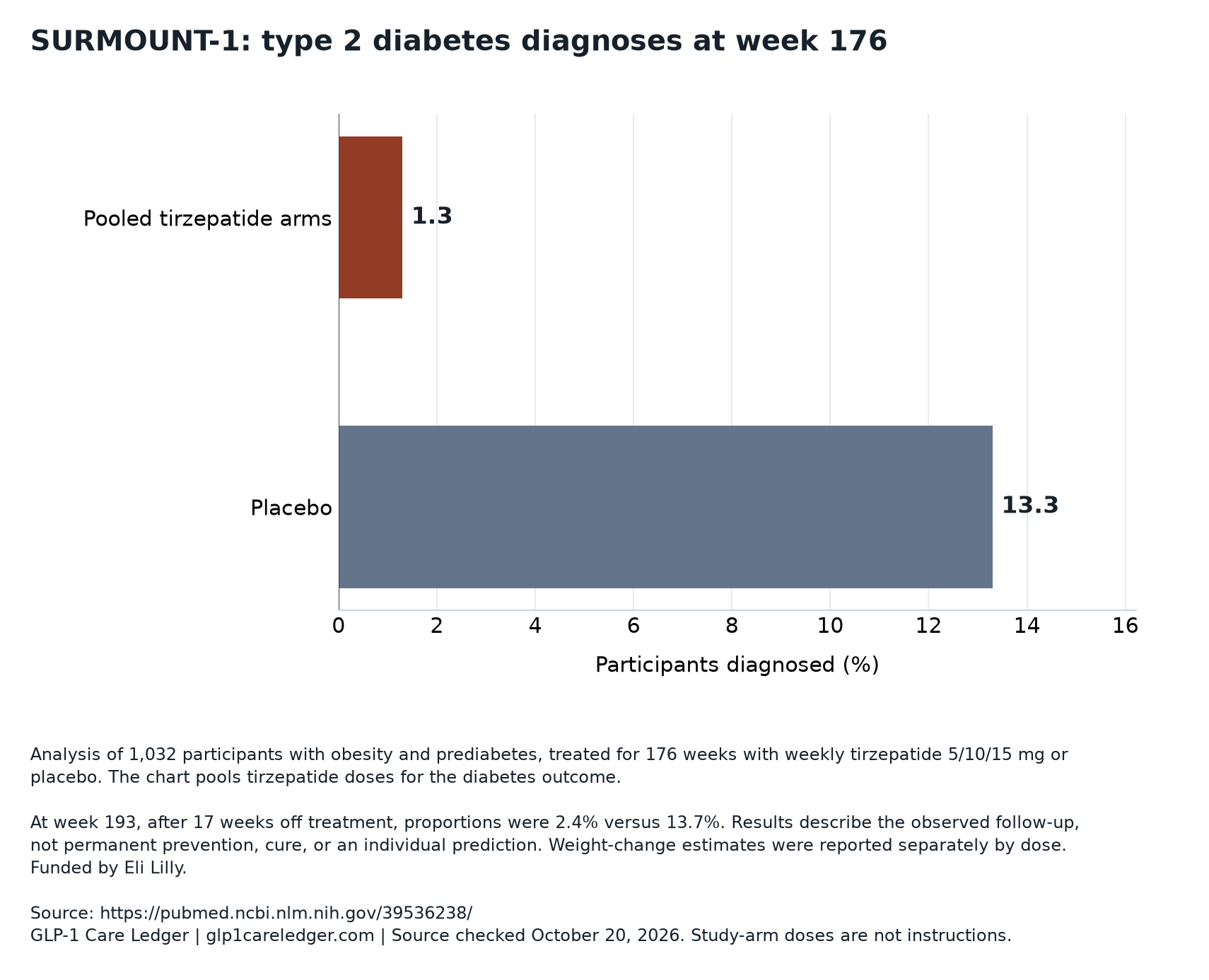
SURMOUNT-1: type 2 diabetes diagnoses at week 176
Analysis of 1,032 participants with obesity and prediabetes, treated for 176 weeks with weekly tirzepatide 5/10/15 mg or placebo. The chart pools tirzepatide doses for the diabetes outcome.
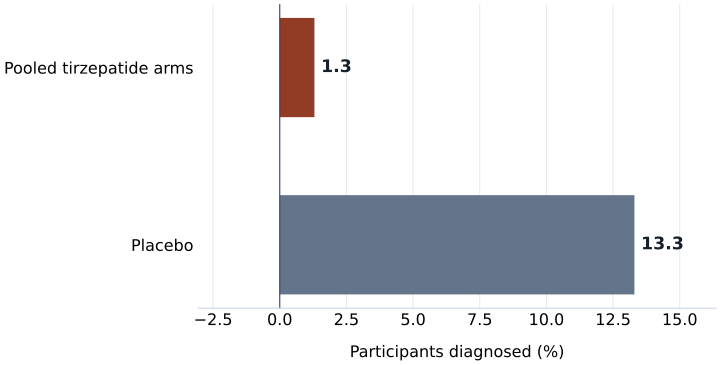
| Study group | Participants diagnosed (%) |
|---|---|
| Pooled tirzepatide arms | 1.3 |
| Placebo | 13.3 |
At week 193, after 17 weeks off treatment, proportions were 2.4% versus 13.7%. Results describe the observed follow-up, not permanent prevention, cure, or an individual prediction. Weight-change estimates were reported separately by dose. Funded by Eli Lilly.
Original visualization of published aggregate data. No individual prediction or provider performance is represented. Original research ↗
Reading 1.3% versus 13.3% without inflating the claim
At 176 weeks, 1.3% of participants in the pooled tirzepatide groups had received a diabetes diagnosis, compared with 13.3% in the placebo group. Subtracting the reported percentages gives a 12.0-percentage-point absolute difference. Expressed as a simple scale illustration, those percentages correspond to about 13 versus 133 diagnoses per 1,000 people. These are translations of reported percentages, not reconstructed trial event counts.
The reported hazard ratio was 0.07, with a 95% confidence interval of 0.0 to 0.1. A hazard ratio compares the rate at which diagnoses occur over follow-up, taking their timing into account. Its point estimate represents an approximately 93% lower hazard, not a 93-percentage-point decrease and not a guarantee for any individual. The rounded lower confidence limit of 0.0 should not be interpreted as proof that the underlying hazard could literally be zero.
The percentage contrast and hazard ratio describe related but different features of the data. A ratio calculated directly from 1.3% and 13.3% need not equal the hazard ratio. Keeping those measures separate preserves the substantial finding without making the statistical claim larger or simpler than it is.
Seventeen weeks off treatment changed the question
By the end of the off-treatment observation, 2.4% of participants previously assigned tirzepatide and 13.7% assigned placebo had diabetes. The reported hazard ratio over the 193-week period was 0.12, with a 95% confidence interval of 0.1 to 0.2. The absolute difference between the reported percentages was then 11.3 percentage points. A large separation remained, but the cumulative percentage in the tirzepatide group had increased.
These numbers do not provide a standalone hazard ratio for the 17 weeks after withdrawal. Nor should subtracting the cumulative percentages be treated as a precise estimate of the off-treatment biological effect: the abstract does not provide the risk-set details, event timing, or handling of missing observations needed for that analysis. It supports a more limited conclusion that the difference persisted through a short period without assigned treatment.
Prevention and delay are therefore both reasonable concepts, but cure and permanent protection are not demonstrated. Years of additional follow-up would be needed to determine whether diagnoses remain durably reduced, are mainly postponed, or converge later. The abstract does not resolve that long-term trajectory.
Weight results were dose-specific; diabetes results were pooled
At week 176, average weight change was −12.3% with 5 mg, −18.7% with 10 mg, and −19.7% with 15 mg, compared with −1.3% with placebo. The corresponding differences from placebo were 11.0, 17.4, and 18.4 percentage points of baseline weight. These are average changes over time, not the percentage of participants who achieved a particular weight-loss threshold.
The indexed abstract does not supply confidence intervals for these week-176 weight estimates. It also does not present separate diabetes estimates for each tirzepatide dose. Consequently, readers cannot combine the dose-specific weight findings with the pooled diabetes result to conclude that one dose delivered a particular level of diabetes protection.
Substantial weight reduction and fewer diabetes diagnoses occurred in the same trial, but their coexistence does not quantify how much diabetes benefit was mediated by weight loss versus other drug effects. That would require additional analyses. Likewise, the scale results alone do not identify changes in muscle or fat; the separate SURMOUNT-1 body-composition article addresses a different measurement question.
| Assigned arm | Mean weight change | Difference from placebo |
|---|---|---|
| Tirzepatide 5 mg | −12.3% | 11.0 percentage points greater reduction |
| Tirzepatide 10 mg | −18.7% | 17.4 percentage points greater reduction |
| Tirzepatide 15 mg | −19.7% | 18.4 percentage points greater reduction |
| Placebo | −1.3% | Reference group |
Why the original 72-week results are not an extension control
The original 72-week SURMOUNT-1 report found mean weight changes of −15.0%, −19.5%, and −20.9% across the three tirzepatide arms, versus −3.1% with placebo. The respective 95% confidence intervals were −15.9 to −14.2, −20.4 to −18.5, −21.8 to −19.9, and −4.3 to −1.9. Those estimates covered the overall trial population, not only the subgroup examined in the three-year diabetes report.
It would therefore be misleading to subtract the 176-week subgroup means from the 72-week overall means and call the differences weight regain. That comparison changes both the observation time and the population. A valid trajectory analysis would follow the same defined participants with compatible statistical methods. The original report's treatment-regimen analysis assessed effects regardless of treatment discontinuation; the supplied extension abstract does not give equivalent methodological detail.
The earlier trial establishes the broader weight-loss context, while the later report adds longer observation and diabetes outcomes in participants with prediabetes. Neither turns the other into an independent replication: they are reports from the same trial, funded by Eli Lilly.
Tolerability belongs beside the benefit estimates
In the three-year report, gastrointestinal events were the most common adverse events other than COVID-19. Most were mild to moderate and occurred chiefly during dose escalation in the first 20 weeks. Investigators reported no new safety signals. That statement means no newly identified safety concern emerged in the reported analysis; it does not mean adverse effects were absent or that every possible risk was excluded.
The original 72-week report provides a concrete measure of tolerability: adverse events led to discontinuation in 4.3%, 7.1%, and 6.2% of participants assigned 5 mg, 10 mg, and 15 mg, respectively, versus 2.6% with placebo. Those are overall-trial figures, not subgroup-specific three-year discontinuation rates. The extended abstract does not provide a detailed numerical breakdown of serious events or longer-term discontinuations.
For interpretation, a large average benefit and meaningful tolerability problems can both be true. Rare harms also require more evidence than a single subgroup can supply. These trial reports are not current prescribing information, and their dose arms should not be converted into a personal treatment plan.
Maintenance research answers a related—but different—question
SURMOUNT-MAINTAIN adds context about ongoing treatment but does not replicate this diabetes-prevention endpoint. It enrolled 441 people into a 60-week open-label tirzepatide period and randomized 378 afterward to continue their maximum tolerated dose of 10 or 15 mg, reduce to 5 mg, or switch to placebo for another 52 weeks. This selected population had already completed an initial treatment period.
At week 112, model-based weight changes from baseline were −21.9%, −16.6%, and −9.9%, respectively. Rescue treatment was allowed after specified regain beginning 24 weeks after randomization, and the analysis accounted for that design feature. These details matter: the placebo group had previously received tirzepatide, unlike a group assigned placebo from the outset. Eli Lilly funded this study as well.
The maintenance findings support studying continued treatment as a long-term issue, not assuming a finite course creates permanent effects. They do not establish that a lower dose preserves SURMOUNT-1's diabetes benefit. The SURMOUNT-4 withdrawal article offers another study-design context; withdrawal, maintenance, and prevention endpoints should remain distinct.
Budget around duration, not an assumed financial payoff
Editorial interpretation: the practical budgeting lesson is to recognize the duration attached to the evidence. The principal diabetes finding followed 176 weeks of assigned treatment, not a short introductory purchase. Neither the prevention abstract nor the maintenance abstract reports medication prices, insurance payments, household spending, or cost-effectiveness. A lower diabetes incidence cannot by itself establish that treatment saves money.
A useful planning distinction is between the clinical observation period and the billing interval. The billing-cycle guide can help distinguish monthly, four-week, and prepaid charges, while the budget workbook organizes an actual written quote. Multiplying a verified recurring charge across a chosen planning horizon is household arithmetic, not a trial-derived estimate of net medical savings.
NIDDK identifies cost, benefit, tolerability, and medical history as considerations in treatment decisions and notes that coverage varies. For documentary contract checks, the Ro review can help frame questions about membership terms. That link does not establish access to the studied product, diabetes-prevention care, or comparable outcomes. No trial result promises reimbursement or unchanged future prices.
Where the evidence stops traveling
The direct evidence concerns a particular injectable treatment, comparator, population, and follow-up. It does not automatically establish the same effect for an oral formulation, another drug, a compounded preparation, or care delivered by a particular provider. FDA states that compounded drugs are not FDA approved or reviewed before marketing for safety, effectiveness, or quality; trial results do not establish their equivalence.
Important scientific details also remain unavailable in the indexed abstract: the precise diabetes ascertainment procedures, subgroup attrition patterns, detailed missing-data handling, and dose-specific diabetes estimates. Randomization strengthens causal interpretation of the assigned-treatment comparison, but it does not eliminate the need to inspect these methods when judging the exact magnitude and robustness of an estimate.
Further work must clarify durability beyond 17 weeks off treatment, variation in response, and whether fewer diagnoses translate into fewer later diabetes complications. Those complications were not established outcomes here. The strongest conclusion is still substantial: among studied participants with obesity and prediabetes, assignment to tirzepatide markedly reduced diabetes progression over the measured period.
For another example of how study populations and endpoints shape interpretation, read our analysis of SELECT. The study answers a different question and should be assessed on its own terms.
Questions & answers
Does this mean tirzepatide permanently prevents diabetes?
No. It substantially reduced diagnoses over the studied period, and a large difference remained after 17 weeks off treatment. That interval is too short to distinguish lifelong prevention from delayed onset. Permanent protection would require much longer follow-up, including careful observation after treatment ends.
Can the diabetes result tell me which dose worked best?
Not from the supplied report. Weight changes were reported separately for 5 mg, 10 mg, and 15 mg, but the diabetes comparison pooled the tirzepatide groups. A larger average weight reduction in one arm does not supply a dose-specific diabetes estimate or justify choosing a personal dose.
Why not describe the hazard ratio as everyone's risk reduction?
A hazard ratio summarizes the relative rate of diagnosis over follow-up in the trial groups. It is not an individual forecast. The observed percentages describe another aspect of the evidence, and a person's absolute benefit may differ with baseline risk, treatment exposure, and other characteristics.
Did the trial show that treatment costs less than developing diabetes?
No economic comparison was reported in the indexed abstract. Establishing that claim would require treatment and follow-up costs, later healthcare use, duration of benefit, and assumptions about future outcomes. Coverage also varies. A household budget can describe expected payments without claiming that those payments will produce net savings.
Do cheaper compounded products inherit these findings?
No. Price does not establish pharmaceutical or clinical equivalence. FDA notes that compounded drugs are not FDA approved or reviewed before marketing for safety, effectiveness, or quality. The SURMOUNT-1 results cannot be assigned automatically to compounded preparations, alternative routes, or a provider's entire treatment program.
Our assessment
SURMOUNT-1 provides strong randomized evidence that tirzepatide reduced progression to type 2 diabetes during extended treatment in participants with obesity and prediabetes. The large absolute difference complements, rather than replaces, the hazard-ratio finding. Its boundaries are equally important: pooled diabetes results do not rank individual doses, short off-treatment observation does not establish a cure, and clinical benefit does not prove economic savings. Evidence-informed budgeting should preserve the study's time horizon while treating prices, contracts, coverage, and continuation costs as separate questions.
Sources & documentation
Scientific and official sources consulted October 20, 2026. Study findings apply to the populations, products and time periods described; they are not provider outcome data.
- Tirzepatide for Obesity Treatment and Diabetes Prevention. ↗
- Tirzepatide Once Weekly for the Treatment of Obesity. ↗
- Tirzepatide for maintenance of bodyweight reduction in people with obesity in the USA (SURMOUNT-MAINTAIN): a multicentre, double-blind, randomised, placebo-controlled trial. ↗
- NIDDK prescription medications for overweight and obesity ↗
- FDA concerns about unapproved GLP-1 drugs ↗