A lower number on the scale does not reveal which tissues changed. In a body-composition substudy of SURMOUNT-1, researchers used dual-energy X-ray absorptiometry, or DXA, to separate changes in fat mass from changes in lean tissue during tirzepatide treatment. The central finding was substantial fat loss accompanied by smaller, but measurable, lean mass loss. Roughly three-quarters of the lost weight was fat and one-quarter was lean tissue—a statement about the composition of weight lost, not the percentage of starting muscle that disappeared.
That distinction matters scientifically and financially. These results describe average changes over 72 weeks in a selected trial sample receiving an injectable study drug and lifestyle counseling. They do not establish muscle strength, an individual’s likely response, or the value of a subscription. This analysis uses the supplied body-composition report, its publisher correction, indexed primary-report abstracts for the parent trial and heart-failure comparison, and official FDA material. It does not represent examination of every protocol or supplement.
At a glance
- Paired-scan analysis
- The analysis included 160 participants: 124 receiving pooled tirzepatide doses and 36 receiving placebo; approximately 73% were female.Sources: [1]
- Different starting denominators
- At 72 weeks, tirzepatide-group body weight, fat mass, and lean mass changed by −21.3%, −33.9%, and −10.9%, respectively.Sources: [1]
- Composition of weight lost
- Approximately 75% of lost weight was fat and 25% was lean tissue in both groups; this does not mean 25% of starting muscle was lost.Sources: [1]
- Corrected figure units
- An August 2025 correction changed Figure 4 fat- and lean-mass axis units to kilograms, not percent; the abstract’s baseline-percentage changes were not corrected.Sources: [3]
- Treatment tolerability
- In the parent trial, adverse events caused discontinuation in 4.3%–7.1% of tirzepatide participants across dose groups, compared with 2.6% receiving placebo.Sources: [2]
A small imaging study inside a much larger trial
SURMOUNT-1 randomized 2,539 adults without diabetes to once-weekly subcutaneous tirzepatide or placebo for 72 weeks, including a 20-week dose-escalation period. Eligibility required a body mass index of at least 30, or at least 27 with a weight-related complication. The 5-, 10-, and 15-mg doses identify research arms, not instructions for treatment.
The DXA substudy enrolled 255 people at 28 sites with suitable scanners. Its efficacy analysis included 160 with baseline and follow-up scans, including scans obtained at early discontinuation. Three missing week-72 observations were filled using an earlier measurement. Thus, the familiar description of a paired-scan subset should not be read as 160 uninterrupted 72-week completers.
Participants averaged 46.2 years of age, 102.5 kg in weight, and a BMI of 38.0; 73.1% were female and 75.6% were White. The analyzed group represented about 6% of the parent trial. Scanner availability and size or hardware restrictions also shaped eligibility, limiting how confidently these averages describe everyone seeking obesity treatment.
What the comparison was designed to answer
The substudy’s primary objective was to test whether pooled tirzepatide doses produced a greater percentage reduction in fat mass than placebo. Lean-mass percentage change and absolute fat- and lean-mass changes were key secondary endpoints. Waist circumference, estimated visceral fat, and the proportions of weight lost as different tissues were exploratory, post hoc analyses.
Both treatment groups received individualized lifestyle counseling. The protocol included dietary and physical-activity goals but no specific strength-training program. Consequently, this was a comparison of tirzepatide plus that counseling against placebo plus counseling—not medication against no intervention, and not a test of a muscle-preservation program.
Pooling increased the number of treated participants available for analysis: 124 receiving tirzepatide versus 36 receiving placebo. It also changed the question. The main results estimate the combined effect across three dose groups, rather than establishing a separate body-composition benefit for each dose or identifying the best dose for preserving lean tissue.
STUDY DATA · GLP-1 Care Ledger
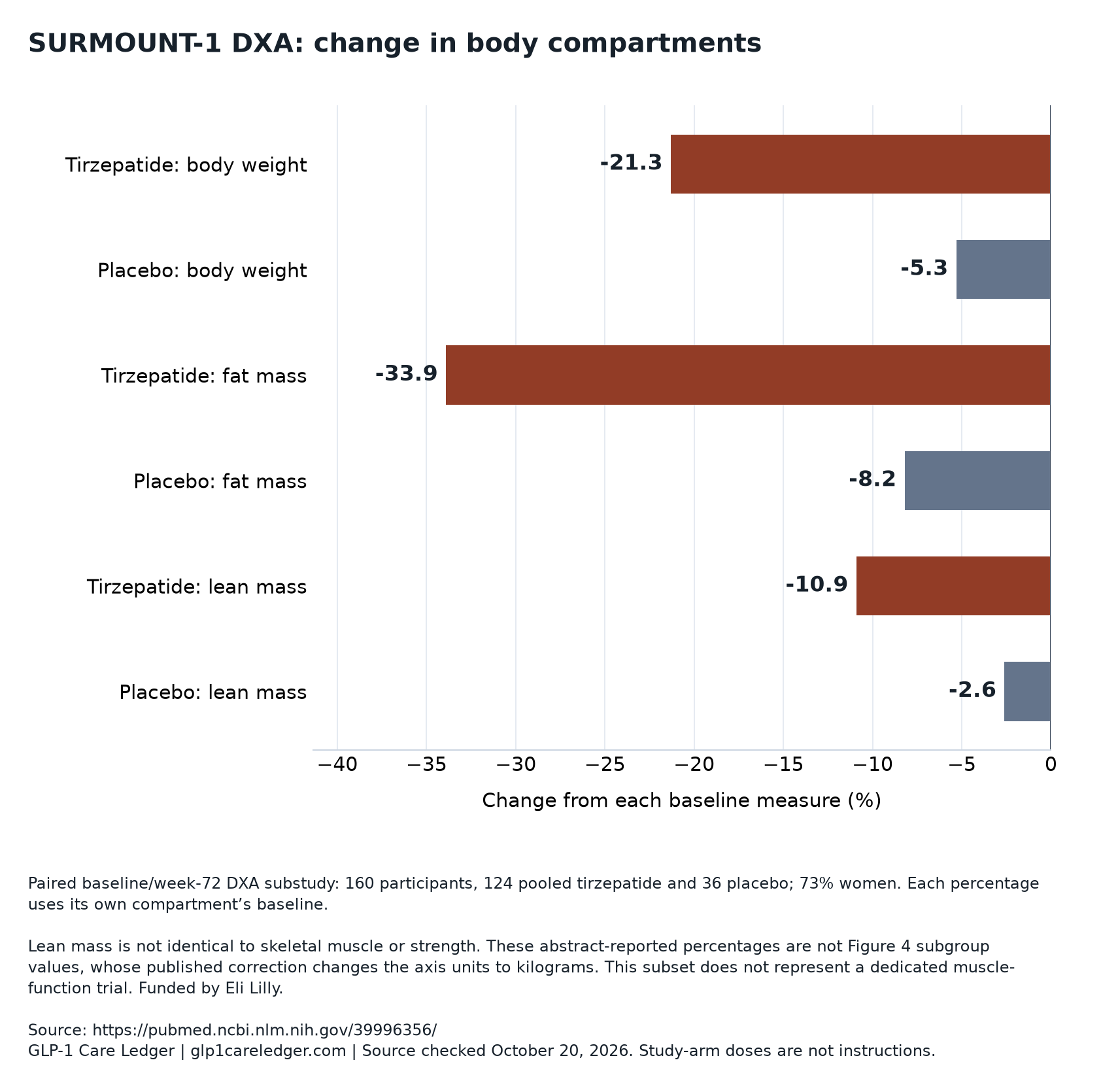
SURMOUNT-1 DXA: change in body compartments
Paired baseline/week-72 DXA substudy: 160 participants, 124 pooled tirzepatide and 36 placebo; 73% women. Each percentage uses its own compartment’s baseline.
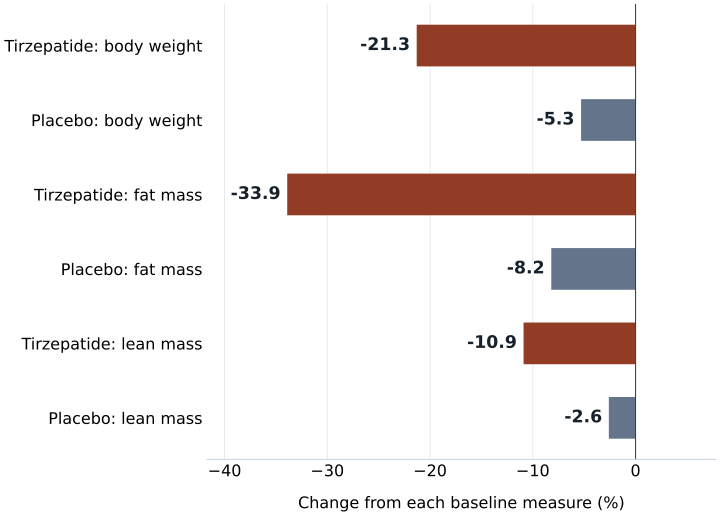
| Study group | Change from each baseline measure (%) |
|---|---|
| Tirzepatide: body weight | -21.3 |
| Placebo: body weight | -5.3 |
| Tirzepatide: fat mass | -33.9 |
| Placebo: fat mass | -8.2 |
| Tirzepatide: lean mass | -10.9 |
| Placebo: lean mass | -2.6 |
Lean mass is not identical to skeletal muscle or strength. These abstract-reported percentages are not Figure 4 subgroup values, whose published correction changes the axis units to kilograms. This subset does not represent a dedicated muscle-function trial. Funded by Eli Lilly.
Original visualization of published aggregate data. No individual prediction or provider performance is represented. Original research ↗
Reading the three percentage changes correctly
The headline percentages have different denominators. Body-weight change uses starting body weight; fat-mass change uses starting fat mass; lean-mass change uses starting lean mass. Tirzepatide’s 33.9% fat reduction therefore cannot be added to its 10.9% lean reduction to calculate overall weight loss. These are changes in separate starting compartments.
Compared with placebo, the estimated difference in fat-mass change was −25.7 percentage points, with a 95% confidence interval from −31.4 to −20.0. For lean mass, it was −8.3 percentage points, with a confidence interval from −10.6 to −6.1. These intervals describe uncertainty around estimated between-group average differences, not the range of responses that individual participants experienced.
The overall weight-change difference was −16.0 percentage points, with a 95% confidence interval from −19.4 to −12.6. All three comparisons had reported P values below 0.001. That supports a treatment-group difference, but statistical significance does not establish whether an individual’s lean loss caused weakness or whether the same changes would continue beyond the measured period.
| Measurement | Pooled tirzepatide | Placebo |
|---|---|---|
| Body weight | −21.3% of starting body weight | −5.3% of starting body weight |
| Fat mass | −33.9% of starting fat mass | −8.2% of starting fat mass |
| Lean mass | −10.9% of starting lean mass | −2.6% of starting lean mass |
Why the 75/25 split is not a muscle-loss percentage
The report’s detailed results attributed 74% of weight reduction to fat and 26% to lean tissue with tirzepatide, compared with 75% and 25% with placebo. The abstract reasonably summarized both as approximately 75/25. The denominator here is the tissue mass lost, not starting body weight, starting lean mass, or starting skeletal muscle.
For a purely illustrative 10-kg loss with that approximate split, 7.5 kg would be fat and 2.5 kg lean tissue. That example says nothing about the percentage of starting muscle lost, because neither starting muscle mass nor muscle-specific change has been supplied. It illustrates a ratio, not a forecast for someone beginning treatment.
The actual estimated absolute losses were 15.9 kg of fat and 5.6 kg of lean mass with tirzepatide, versus 3.6 kg and 1.2 kg with placebo. A similar proportional split therefore coexisted with substantially greater absolute lean loss. Similar proportions should not be mistaken for similar quantities or proof that lean-tissue changes are clinically irrelevant.
DXA measures tissue compartments, not strength
In this report, lean mass means lean soft tissue: fat-free mass excluding bone mineral content. It includes skeletal muscle but also water and other nonfat soft tissues. DXA does not turn that combined measurement into a direct assessment of muscle fibers, muscle quality, grip strength, or the ability to rise from a chair.
The imaging procedures attempted to reduce measurement variation. Participants were to use the same scanner and software under similar conditions, including consistent hydration and positioning, and a blinded central reader evaluated scans. Those safeguards strengthen the comparison, while also showing why a lean-mass number cannot be interpreted independently of measurement conditions.
The estimated between-group difference in absolute lean-mass change was −4.4 kg, with a 95% confidence interval from −5.6 to −3.2. That is a meaningful tissue-compartment finding. Whether it represented harmful muscle loss, appropriate adaptation to carrying less weight, changes in other tissues, or some combination requires measurements that the DXA analysis did not provide.
Abdominal fat fell, but the measurement has boundaries
Tirzepatide participants had an estimated 40.1% reduction in visceral fat mass, compared with 7.3% with placebo. The between-group difference was −32.8 percentage points, with a 95% confidence interval from −42.8 to −22.8. Waist circumference decreased by 18.1 cm versus 3.4 cm, an estimated difference of −14.7 cm.
Visceral fat was estimated by scanner software from an abdominal region, subtracting an estimate of subcutaneous fat. It was not a direct measurement of every internal fat deposit. The finding supports a change in central adiposity, but the substudy did not establish how much that change independently contributed to later disease outcomes.
This distinction separates body-composition research from outcome trials. A smaller waist or lower estimated visceral fat is not itself evidence of fewer heart attacks or kidney events in this sample. The different endpoint questions are explored in SELECT cardiovascular outcomes; its results should not be imported into this DXA comparison.
Subgroups and the corrected figure need restrained interpretation
Researchers examined age, sex, and thirds of achieved weight loss after the main analysis. Broadly, fat accounted for most weight lost across these groups. Participants losing more total weight also lost more fat and lean tissue in absolute terms. Because achieved weight loss was not randomly assigned, those comparisons cannot show that pursuing a particular amount of loss causes a particular tissue response.
Small groups make apparent exceptions difficult to interpret. The report identified only nine placebo participants aged 50 to under 65, for example, and warned against conclusions based on nominal subgroup differences. Broad consistency is useful supporting evidence, but it does not establish equal effects across ages or exclude vulnerability in people with low strength or low muscle reserves.
A publisher correction issued August 20, 2025, changed Figure 4’s fat- and lean-mass vertical-axis units from percent to kilograms. The correction concerns the weight-loss-tertile figure, not the abstract’s percentage changes. The table above deliberately uses the reported baseline-percentage results rather than relabeling or reconstructing the corrected figure.
Function is a separate question that needs separate endpoints
The body-composition paper notes improved patient-reported physical function in the broader SURMOUNT-1 population despite lean-mass reductions. That is compatible with people finding movement easier after substantial weight loss. It does not demonstrate that muscle strength improved in the 160-person imaging sample or establish which tissue changes explained those reports.
A useful contrast is STEP-HFpEF, a separate Novo Nordisk-funded trial of semaglutide in 529 people with obesity and heart failure with preserved ejection fraction. Over 52 weeks, its dual primary endpoints assessed a heart-failure symptom and limitation score and body weight. It also measured six-minute walking distance: the between-group improvement was 20.3 meters, with a 95% confidence interval of 8.6 to 32.1.
Those walking data illustrate what direct performance measurement adds; they are not tirzepatide results or proof of muscle preservation. The STEP-HFpEF symptoms and function analysis addresses that distinct population and endpoint set. For the DXA question, unresolved priorities include direct strength testing, repeated functional assessments, and longer observation of people at greater risk of disability.
| Measurement | What it establishes | What it does not establish |
|---|---|---|
| DXA lean soft tissue | Estimated mass of nonfat soft tissue | Muscle-specific loss or strength |
| Patient-reported physical function | Participants’ perceived limitations | Measured muscle force |
| Six-minute walking distance | Observed walking performance | Which tissue change caused improvement |
Safety and missing observations matter alongside fat loss
The parent SURMOUNT-1 abstract reported gastrointestinal adverse events as the most common events with tirzepatide. Most were mild to moderate and occurred primarily during dose escalation. Adverse events caused treatment discontinuation in 4.3%, 7.1%, and 6.2% of the 5-, 10-, and 15-mg groups, respectively, versus 2.6% with placebo. A favorable fat-loss result does not erase those tolerability findings.
The parent trial’s treatment-regimen estimates, which assessed effects regardless of discontinuation, were −15.0%, −19.5%, and −20.9% weight change across the three doses, versus −3.1% with placebo. These should not be substituted for the DXA sample’s pooled −21.3% and −5.3%. Different populations and analysis approaches can produce different valid estimates.
Only 160 of 255 substudy enrollees entered the paired-scan efficacy analysis, so missing scans remain an interpretive concern. The analysis also lacked multiplicity adjustment across its many comparisons and did not evaluate nutrient intake or activity in relation to composition. Eli Lilly funded the study and participated in design, analysis, interpretation, and reporting; that involvement belongs alongside the methodological limitations when weighing confidence.
Budget for a measured treatment period, not a promised body composition
Editorial interpretation: a 72-week research endpoint provides a time horizon for understanding evidence, not a recommended purchase duration or a cost-effectiveness calculation. This substudy did not measure subscription costs, insurance spending, continuation expenses, or the financial return from losing fat. A budget built from a written quote and a check of billing-cycle definitions address financial questions the trial cannot answer.
The study also did not test body composition after withdrawal or compare continuation strategies. Those questions require other designs, such as the randomized-withdrawal evidence discussed in SURMOUNT-4 maintenance. For documentary checks only, the Ro review can help frame questions about membership and medication charges; that link does not imply access to the studied product or comparable outcomes.
Product identity is another boundary. FDA states that compounded drugs are not FDA approved or reviewed before marketing for safety, effectiveness, or quality, and reports dosing-error concerns. These injectable trial results do not establish equivalence for compounded preparations, oral products, other formulations, or a provider’s care model. The approved-versus-compounded pricing guide keeps that distinction separate from price comparisons.
Questions & answers
Does the study show that tirzepatide causes a loss of 25% of starting muscle?
No. Approximately 25% refers to lean tissue’s share of the weight lost. Starting lean mass declined by an estimated 10.9% in the pooled tirzepatide group, and DXA lean mass is not identical to skeletal muscle. Neither statistic supplies a muscle-specific percentage or establishes a corresponding change in strength.
Was lean tissue preserved because the fat-to-lean ratio resembled placebo?
Not in the sense of avoiding lean loss. Both groups lost lean tissue, and the tirzepatide group lost more in absolute terms. The similar ratio means that greater overall loss was not accompanied by a markedly different average partition between fat and lean tissue. It does not establish that every participant retained adequate muscle reserves.
Did the correction invalidate the main percentage results?
The supplied publisher correction addresses Figure 4’s axis labels: fat- and lean-mass changes there should be expressed in kilograms. It does not correct the abstract’s baseline-percentage changes. The practical lesson is to check each figure’s units and denominator rather than treating every number in a body-composition report as a percentage.
Can these results identify the best nutrition or exercise approach?
No. The substudy was not a randomized comparison of protein strategies or exercise programs, and it did not analyze how nutrient intake or physical activity related to DXA changes. Its findings support asking better research questions about tissue preservation, but they do not establish a specific protein dose, exercise target, or universally effective preservation plan.
Does a more expensive program offer better fat loss or muscle preservation?
This trial cannot answer that. It compared study treatment with placebo, not providers, prices, contracts, or levels of commercial support. Editorially, financial comparisons should distinguish documented services and product identity from untested outcome promises. Neither a higher price nor a lower advertised price demonstrates equivalence to the study conditions or a better body-composition result.
Our assessment
The strongest conclusion is specific: in this selected SURMOUNT-1 imaging sample, pooled tirzepatide produced substantially greater fat loss and greater lean-tissue loss than placebo over the studied period, with fat accounting for roughly three-quarters of the loss. The evidence is more informative than scale weight alone, but it does not resolve muscle-specific changes, strength, disability risk, or long-term body composition after treatment changes. For budgeting, the defensible interpretation is to separate demonstrated biological effects from unmeasured economic promises. A trial endpoint is evidence about treatment—not a guarantee attached to a provider, formulation, contract, or payment schedule.
Sources & documentation
Scientific and official sources consulted October 20, 2026. Study findings apply to the populations, products and time periods described; they are not provider outcome data.
- Body composition changes during weight reduction with tirzepatide in the SURMOUNT-1 study of adults with obesity or overweight. ↗
- Tirzepatide Once Weekly for the Treatment of Obesity. ↗
- Correction to "Body composition changes during weight reduction with tirzepatide in the SURMOUNT-1 study of adults with obesity or overweight". ↗
- Semaglutide in Patients with Heart Failure with Preserved Ejection Fraction and Obesity. ↗
- FDA concerns about unapproved GLP-1 drugs ↗